An enclosed raised bed garden combines organized growing beds with physical barriers that protect vegetables from rabbits, deer, voles, gophers, and other garden visitors. The best design starts with sunlight, drainage, bed access, and practical paths—then adds the right fence for the pests you actually have.
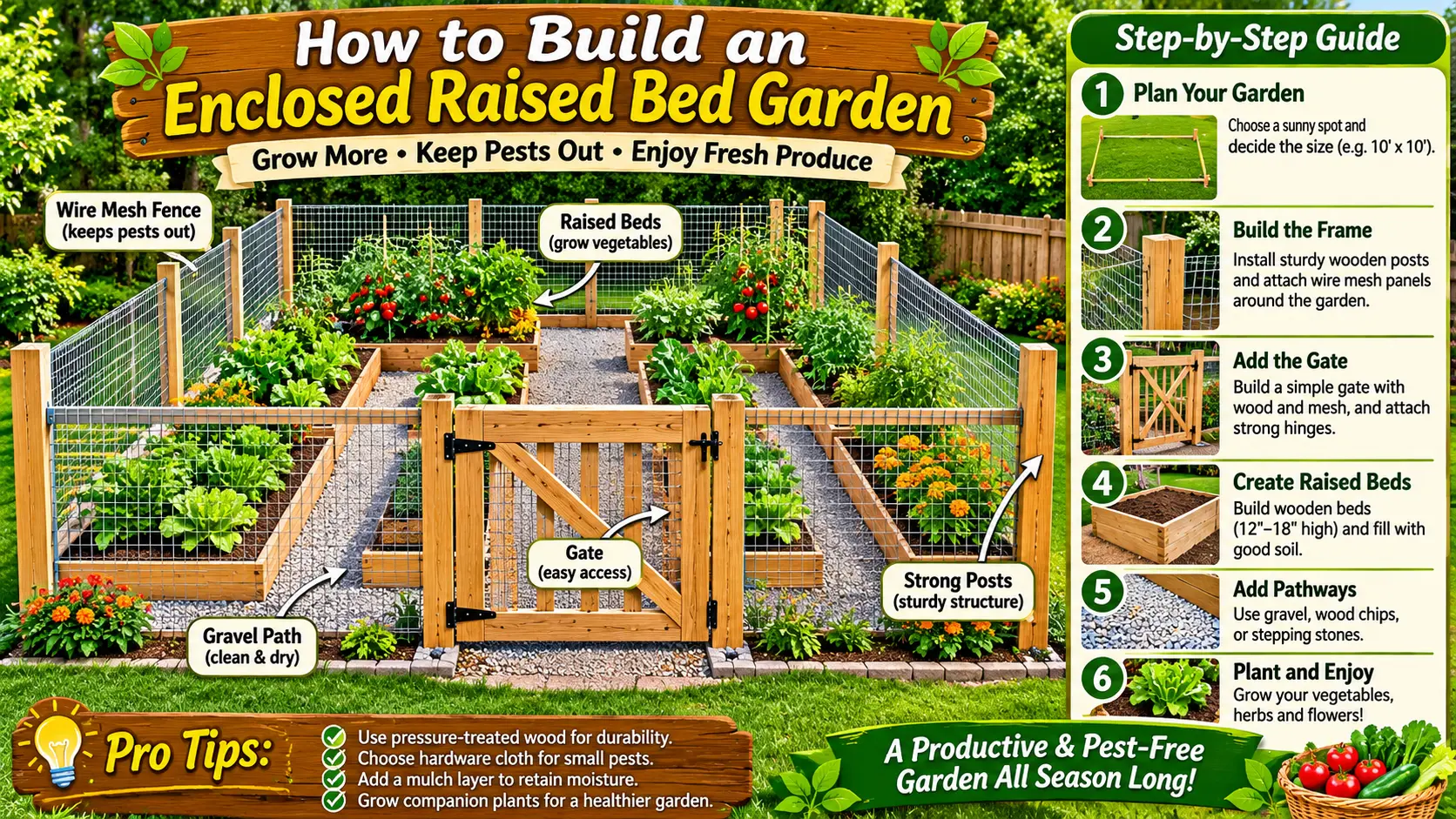
The Pinterest layout gets many useful ideas right: separate raised beds, a wide central path, gravel walkways, a wheelbarrow-friendly gate, perimeter fencing, and hardware cloth beneath vulnerable beds. But some dimensions should be treated as starting points rather than universal rules.
Quick answer: build beds narrow enough to reach from the paths, give yourself one wide working route, use small-mesh barriers near ground level for rabbits, add hardware cloth beneath beds where burrowing rodents are a problem, and use a much taller fence if deer are the real threat.
1. Choose the Site Before Designing the Fence
An enclosure cannot fix a poorly located vegetable garden.
Start with a site that has:
- Strong sunlight for the crops you want to grow
- Good drainage
- Convenient access to water
- Enough room around the outside for fence maintenance
- A practical route from the house or shed
Do not use the shadiest corner of the yard just because it is easiest to fence.
2. Identify the Animal You Are Designing Against
A critter-proof garden works best when the barrier matches the pest.
| Problem Animal | Main Defense |
|---|---|
| Rabbits | Small-mesh low fencing with no gaps at ground level |
| Deer | Much taller perimeter fence or another deer-exclusion design |
| Voles / gophers | Hardware cloth beneath raised beds |
| Birds | Crop-specific netting or row cover where appropriate |
| Insects | Fine insect netting or row cover, not deer fence |
3. Do Not Assume a 4-Foot Fence Will Stop Deer
This is the biggest correction I would make to the Pinterest graphic.
A normal waist-high garden fence may discourage rabbits and pets, but it should not automatically be labeled deer-proof.
Where deer pressure is serious, plan a taller exclusion fence or another proven deer-control design appropriate for your property.
4. Rabbits Need Small Mesh Near the Ground
Large welded-wire openings may allow young rabbits to pass through.
Use smaller mesh near the bottom of the fence and keep the bottom tight to the soil or buried where needed.
The upper part of the enclosure can use larger mesh if deer are not the target.
5. Hardware Cloth Under the Beds Can Stop Burrowers
The hardware-cloth detail in the image is one of its strongest ideas.
Where voles, pocket gophers, or similar burrowing pests are a real problem, attach metal hardware cloth across the bottom before filling the bed.
Use corrosion-resistant material and overlap or secure edges carefully so rodents cannot simply enter beside the mesh.
6. Do Not Add a Solid Bottom Barrier Without a Reason
Hardware cloth is different from a solid liner.
A solid plastic or impermeable layer under a normal raised bed can restrict drainage and root growth.
If you do not have burrowing pests, leaving the bed open to the soil below is often simpler.
7. Keep Most Beds Reachable From Both Sides
FarmSolo’s existing raised-bed layout guide recommends keeping most beds around 3 to 4 feet wide when you can access them from both sides.
The goal is to reach the center without stepping into the soil.
Beds along the perimeter fence may need to be narrower because you can usually work them from only one side.
8. The 12–18 Inch Bed Height Is Optional
The image suggests 12–18 inch tall beds.
That can be comfortable, but every bed does not need to be that tall.
Bed height depends on:
- Existing soil quality
- Accessibility needs
- Crop root depth
- Amount of fill material available
- Drainage
- Budget
9. Taller Beds Do Not Automatically Mean Deeper Roots
If the raised bed is open to healthy soil underneath, roots can often grow below the wooden frame.
Do not spend money filling extremely deep boxes unless height serves a clear purpose such as accessibility or poor native soil.
10. Leave One Main Wheelbarrow Path
The Pinterest design’s 3–4 foot path concept is practical for the main route.
You need enough width to:
- Push a wheelbarrow
- Carry compost
- Move harvest baskets
- Turn around comfortably
- Work around mature plants spilling over the beds
Not every side path needs the same width, but the main route should be genuinely usable.
11. Make the Gate Wider Than the Wheelbarrow
A 36-inch gate may work for some wheelbarrows, but do not copy that number blindly.
Measure your widest garden equipment first, then give yourself extra room for hands, wheels, plants, and an imperfect approach angle.
The right gate width is the one that lets your actual equipment pass comfortably.
12. Prevent the Gate From Becoming the Weak Point
A perfect fence does not help if rabbits can squeeze under the gate or deer can push it open.
Check:
- Gap under the gate
- Gap beside hinges
- Latch height
- Whether wind can blow it open
- Whether the posts remain square
13. Gravel Paths Can Work Well—If Drainage Is Already Good
Gravel can create a clean, low-mud working surface and makes the enclosure feel organized.
But gravel does not magically fix a low, waterlogged yard.
Grade the site first so water has somewhere to go, then install your path material.
14. Mulch Is Another Good Path Option
Wood chips can be cheaper than gravel and comfortable to walk on.
The tradeoff is that organic paths gradually break down and need refreshing.
Choose path material based on drainage, budget, maintenance, and how permanent you want the garden to be.
15. Separate Beds Make Crop Rotation Easier
Multiple beds can simplify crop rotation because each box becomes a clearly defined growing zone.
University of Minnesota notes that several smaller beds can help with rotation, especially for managing soil-borne disease problems.
But crop rotation is not magic. It works best when you track plant families rather than simply changing vegetables at random.
16. Do Not Rotate Tomatoes to a Bed That Just Had Peppers
Tomatoes, peppers, eggplants, potatoes, and tomatillos are in the same plant family.
Moving tomatoes into last year’s pepper bed is not a meaningful family rotation.
Keep simple garden records so you know what grew in each box.
17. L-Shaped Beds Can Use Corners Efficiently
The L-shaped beds in the Pinterest layout can make good use of perimeter corners.
But measure reach before building.
An impressive-looking corner bed can become frustrating if the inside corner is too far away to weed or harvest without stepping on the soil.
18. Keep Beds Away From the Fence Where Needed
Do not press every bed tightly against the enclosure simply to maximize planting space.
You may need room to:
- Repair wire
- Replace fence posts
- Cut weeds outside the fence
- Reach the back of tall crops
- Inspect for burrowing
19. Plan Trellises Before You Fill Every Bed
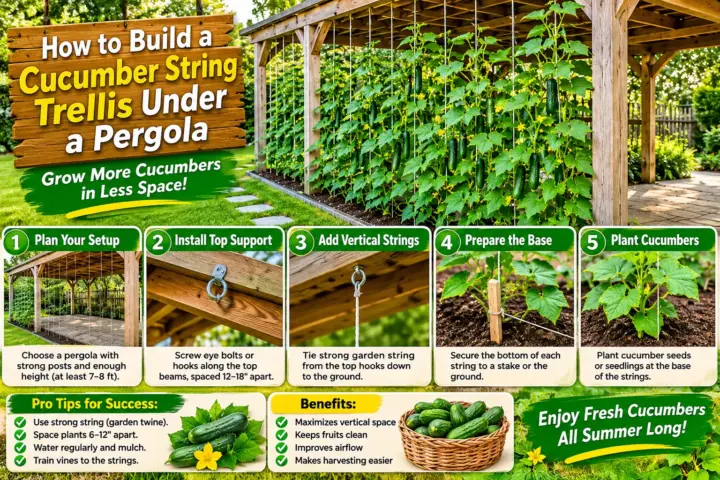
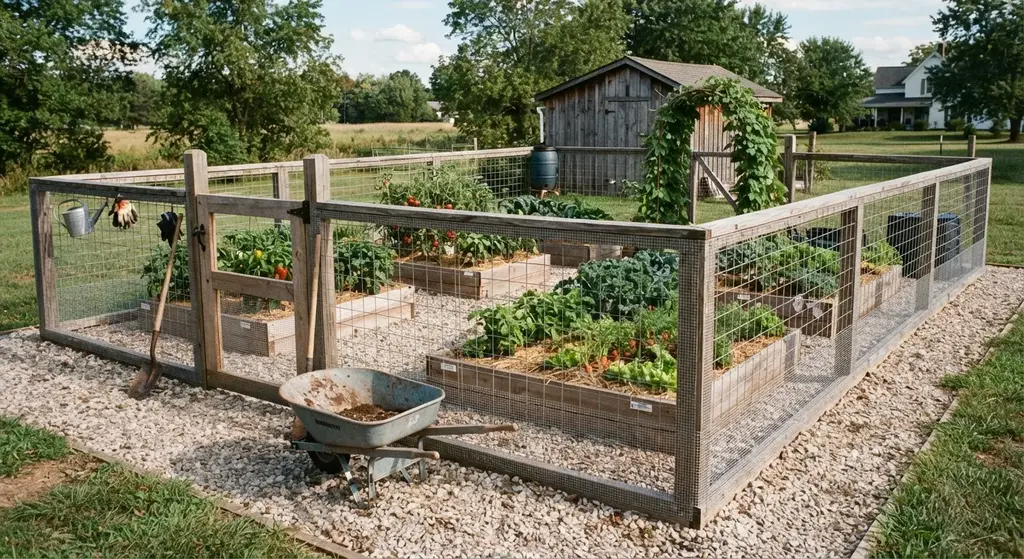
An enclosed garden is ideal for adding trellises to selected beds for cucumbers, peas, beans, and indeterminate tomatoes.
Install structural supports before vines get large and position tall crops so they do not unnecessarily shade shorter vegetables.
20. Do Not Use the Perimeter Fence as Every Trellis
It may be tempting to cover the enclosure fence with beans, cucumbers, squash, and flowers.
That can make fence inspection difficult and may create enough foliage for animals to climb, push, or hide damage.
Use dedicated trellises where possible, especially for heavy vines.
21. Add Row Covers for Insects and Small Critters
A perimeter fence cannot stop cabbage moths, flea beetles, or many other insect pests.
Raised beds make it easy to install hoops and floating row cover over selected crops.
Remove or manage covers appropriately for crops that need pollinator access during flowering.
22. Put Irrigation in Before the Garden Gets Crowded
Drip lines or soaker systems are much easier to install before every bed is full of mature crops.
Plan one main water route and branch into individual beds rather than dragging hoses across paths all season.
23. Keep a Hose From Becoming a Gate Trip Hazard
The main entrance should remain clear because it is where you will repeatedly carry tools, compost, seedlings, and harvested vegetables.
Route irrigation along bed edges or underground where appropriate instead of across the gate opening.
24. Use Safe Raised-Bed Materials
Choose durable materials suitable for contact with garden soil.
Cedar and other naturally durable woods are popular choices. If using reused lumber, know its history and avoid questionable material contaminated with chemicals, oils, or old coatings.
25. Protect the Wood Without Contaminating the Garden
If you apply a stain or preservative, choose a product appropriate for the intended garden use and follow the label.
Do not improvise with leftover exterior chemicals just because the boards are outdoors.
26. Sink Fence Posts for the Conditions You Actually Have
The Pinterest image suggests setting 4×4 posts 24 inches or more into the soil.
Do not use that as a universal footing rule.
Required embedment depends on:
- Fence height
- Soil type
- Wind exposure
- Frost depth
- Post spacing
- Gate weight
- Local building requirements
27. Tall Deer Fences Catch More Wind
If you build an 8-foot enclosure for deer, the structure becomes much more demanding than a simple rabbit fence.
Posts, braces, corners, gates, and attachments all need to handle the taller fence and greater wind exposure.
28. Consider a Double Fence Where a Tall Deer Fence Is Not Practical
Some deer-exclusion strategies use two shorter fences separated by space rather than one very tall barrier.
This takes more yard area, so it is not ideal for every backyard, but it can be worth considering where deer pressure is high.
29. Leave Space for Pollinators
An enclosed vegetable garden does not need to be sterile.
Include appropriate flowering herbs or flowers where they will not block paths or crowd vegetables.
The goal is to exclude problem animals without excluding beneficial insects.
30. Check the Fence Regularly
A garden enclosure is not maintenance-free.
Walk the perimeter and look for:
- Loose wire
- Gaps at the soil line
- Burrows
- Rotting posts
- Sagging gates
- Vegetation pushing against the mesh
- Branches that could fall onto the fence
A Practical Enclosed Garden Layout
| Area | Best Use |
|---|---|
| Center beds | Main rotating vegetable crops |
| Perimeter beds | Compact crops, herbs, or selected trellises |
| Main path | Wheelbarrow, compost, harvest access |
| Gate area | Keep clear of hoses and overhanging plants |
| Sunny north/back edge | Tall trellises where they create the least unwanted shade |
What This Pinterest Layout Gets Right
- Separates growing beds from walking paths.
- Uses several beds to simplify crop planning.
- Provides a large central working path.
- Includes a gate sized for equipment rather than only people.
- Uses hardware cloth beneath beds where burrowers may be a problem.
- Uses gravel to reduce muddy access.
- Uses perimeter beds efficiently.
- Keeps every growing area accessible from a path.
What I Would Correct Before Building It
- Do not assume the illustrated welded-wire height will exclude deer.
- Use small mesh near ground level if rabbits are the main problem.
- Use hardware cloth beneath beds only where burrowing pests justify it.
- Do not treat 24-inch post depth as a universal structural specification.
- Measure your wheelbarrow before choosing a 36-inch gate.
- Keep perimeter beds narrow enough to work from inside the enclosure.
- Do not install gravel until drainage is understood.
- Plan irrigation and trellises before filling every bed.
Enclosed Raised Bed Garden FAQ
How tall should a garden fence be for deer?
Where deer pressure is serious, extension guidance commonly recommends a fence around 8 feet tall, although other designs such as double fencing can also be used in some situations.
How tall should a rabbit fence be?
A fence around 2 feet high with small mesh can exclude cottontail rabbits when the bottom is tight to the ground or buried so they cannot crawl underneath.
Should I put hardware cloth under raised beds?
If voles, pocket gophers, mice, or similar burrowing pests are a recurring problem, hardware cloth can be useful. If burrowers are not a problem, a bottom barrier may be unnecessary.
How wide should raised beds be?
About 3–4 feet is a useful target when you can reach the bed from both sides. Beds worked from only one side should be narrower.
How wide should paths be?
Base path width on how you work. A main route used by a wheelbarrow or garden cart should be wider than simple footpaths. Around 3 feet is often a practical starting point for equipment access.
Is gravel or wood chip better between raised beds?
Both can work. Gravel is more permanent and stays firm when properly installed; wood chips are cheaper and softer underfoot but decompose and need replenishment.
Does fencing stop garden insects?
No. Deer and rabbit fencing does little against insect pests. Use crop-specific row covers, insect netting, monitoring, and integrated pest management where needed.
The Bottom Line
The Pinterest garden is a strong starting concept because it combines raised beds, permanent paths, crop rotation zones, a useful gate, and physical pest barriers in one organized space.
The biggest improvement is to design the enclosure around the animals you actually need to exclude. Rabbits, deer, and burrowing rodents require different barriers. Once that is solved, keep beds reachable, leave a real working path, plan water and trellises before planting, and make the enclosure easy to maintain year after year.
Sources
- University of Minnesota Extension — Raised Bed Gardens
- Colorado State University Extension — Vegetable Gardening in the Mountains
- Colorado State University Extension — Rabbit, Ground Squirrel, and Deer-Resistant Plants
- Oregon State University Extension — Raised Bed Gardening
- Penn State Extension — Cottontail Rabbits