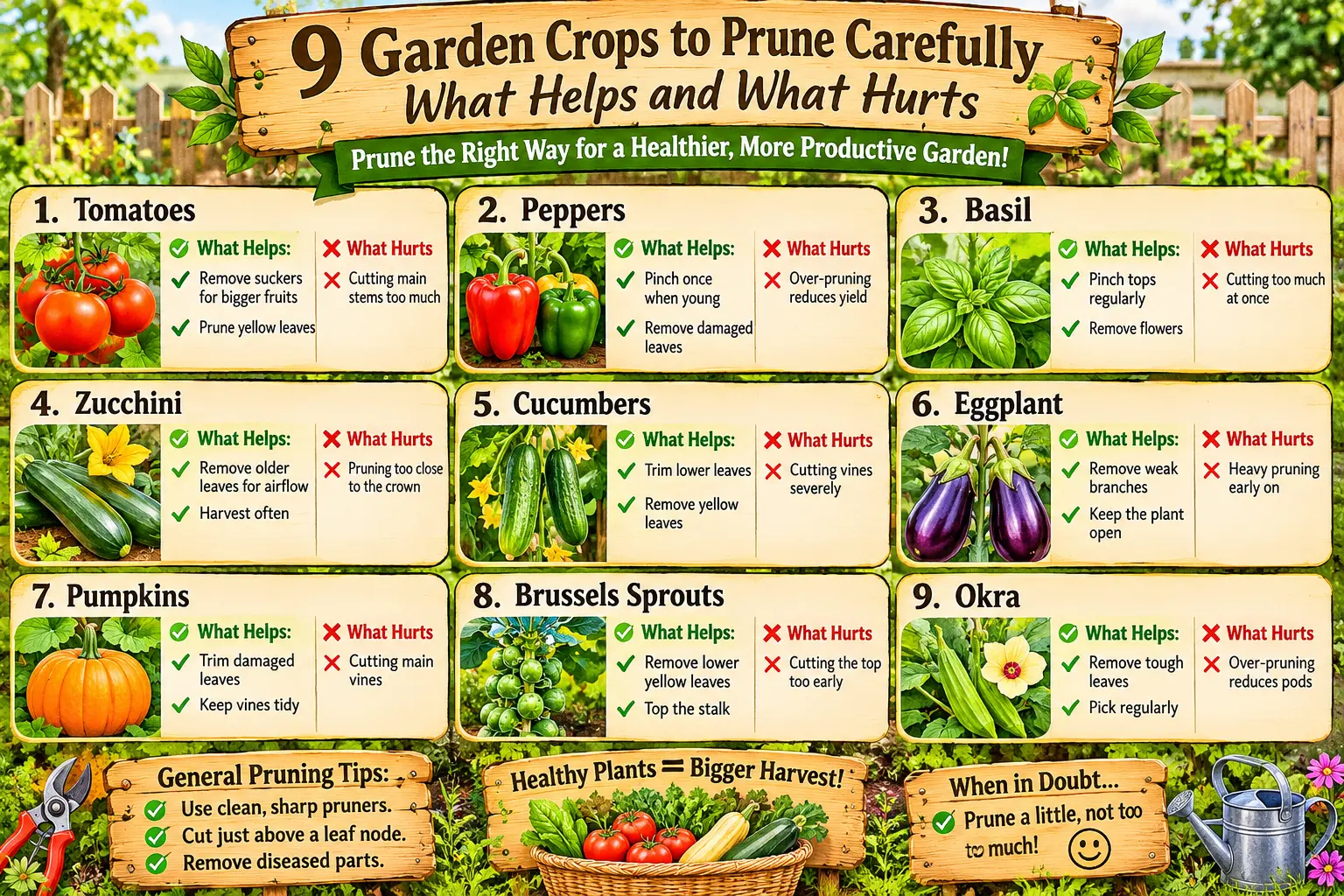
9 Garden Crops to Prune Carefully: What Helps and What Hurts
Pruning can make some vegetable and herb plants easier to manage, improve airflow, encourage useful branching, or help fruit ripen—but cutting more leaves does not automatically mean a bigger harvest.
Some crops respond well to selective pruning. Others need most of their foliage to capture sunlight and produce the energy required for flowers and fruit.
FarmSolo rule: prune for a specific reason—disease control, airflow, plant training, leaf harvest, or end-of-season ripening. Do not remove healthy foliage simply because a social-media graphic says every crop will produce more after pruning.
1. Tomatoes: Prune According to Growth Type
Tomatoes are probably the crop most commonly associated with pruning, but the first question should always be whether you are growing a determinate or indeterminate variety.
Indeterminate Tomatoes
Indeterminate tomatoes continue producing new stems, leaves, flowers, and fruit until frost. Removing selected suckers can make them easier to trellis and can improve airflow around the foliage.
A sucker is the new shoot that develops in the angle between the main stem and a leaf.
Remove unwanted suckers while they are still small rather than waiting until they become thick branches.
Determinate Tomatoes
Determinate tomatoes produce a more limited amount of vegetative growth and fruiting stems.
Heavy pruning can remove branches that would have produced tomatoes.
For these plants, concentrate on damaged foliage, leaves touching the soil, and any disease problems rather than continuously removing suckers.
Better than “remove suckers weekly”: identify your tomato type first. Selective pruning is useful for many indeterminate plants, while aggressive pruning of determinate tomatoes can reduce yield.
2. Peppers: Early Pinching Is Optional
Young pepper plants can sometimes be pinched once to encourage a bushier shape.
University of Minnesota Extension suggests pinching peppers when they have about three to four sets of fully developed leaves, removing the growing tip while leaving two full sets of leaves.
However, this should not be interpreted as a guarantee of higher yield in every climate or variety.
Once plants are fruiting strongly, regular harvesting, consistent moisture, warmth, and healthy foliage usually matter more than continued pruning.
3. Basil: Pinching Really Does Help
Basil is one of the clearest examples where regular pruning is useful.
When harvesting a stem, cut just above a pair of leaves. New shoots will emerge from the nodes below the cut and create a fuller plant.
Flowering also changes the plant’s growth pattern.
If your goal is a long harvest of tender leaves, pinch flower buds before they mature.
Best practice: harvest basil frequently by cutting stems above leaf pairs instead of repeatedly picking only individual leaves.
4. Zucchini: Remove Problem Leaves, Not Healthy Ones by Habit
The Pinterest advice says to remove lower zucchini leaves for airflow.
There can be good reasons to remove individual leaves, especially when they are:
- Badly affected by disease
- Broken or damaged
- Dead or dying
- Lying directly on wet soil
- Making it impossible to reach fruit safely
But healthy zucchini leaves are solar panels for the plant. They produce the carbohydrates that support fruit growth.
Removing a large amount of healthy foliage can also leave fruit more exposed to sunscald.
As a general disease-management rule, University of Minnesota advises against removing more than about one-third of a plant’s foliage at once.
5. Cucumbers: Trellising Is Usually More Important Than Pruning
Cucumber pruning depends heavily on the growing system and variety.
For an ordinary backyard garden, you do not need to routinely remove every lower side shoot to get a useful harvest.
Instead, focus on:
- Trellising vining types when useful
- Keeping leaves dry when watering
- Providing consistent moisture
- Harvesting cucumbers regularly
- Removing diseased foliage when necessary
University of Minnesota notes that leaving overmature cucumbers on the vine can reduce continued production, so frequent harvesting often does more for yield than arbitrary vine pruning.
6. Eggplant: Do Not Automatically Limit Every Plant to Three or Four Branches
The infographic recommends limiting eggplant to three or four main branches.
That may be part of some intensive commercial or greenhouse training systems, but it is not a universal requirement for a backyard eggplant.
For home gardens, strong support, consistent watering, healthy foliage, and frequent harvest are usually more important.
Eggplant fruit can even suffer sunscald if too much protective foliage is removed during hot weather.
Prune dead, diseased, crowded, or badly damaged growth when needed, but do not reduce every plant to a fixed branch number simply because of a graphic.
7. Pumpkins: Do Not Remove the Plant’s Solar Panels
Pumpkin vines can grow far beyond the space you expected, which makes trimming tempting.
If a vine is invading a pathway or another crop, trimming the tip can help control its spread.
But cutting large amounts of healthy leaves simply to “send energy to the fruit” can have the opposite effect.
Leaves are where photosynthesis occurs. Removing them reduces the plant’s ability to produce energy.
University of Maine Extension advises against generally trimming healthy pumpkin foliage for this reason.
When pumpkin pruning makes sense
- A vine has grown completely outside its allotted space.
- Leaves or stems are badly diseased.
- The season is nearly over and you are managing excessive new vine growth.
8. Brussels Sprouts: Topping Can Be Useful Near Harvest
Brussels sprouts are one crop where a carefully timed topping can make sense.
Topping means removing the growing point at the top of the stalk.
Research from University of New Hampshire found that topping can improve marketable yield under some conditions, particularly when the goal is a concentrated once-over harvest.
However, timing is critical.
If plants are topped too early, they may start producing unwanted new growth, reducing yield and quality.
Better advice: topping Brussels sprouts is a late-season harvest-management technique, not routine pruning throughout the growing season.
9. Okra: Keep Healthy Leaves Unless You Have a Reason to Remove Them
Tall okra plants naturally develop older leaves lower on the stalk as the season progresses.
Removing a yellow, diseased, broken, or badly damaged lower leaf is reasonable.
But stripping healthy lower leaves simply because the plant is tall should not be presented as a guaranteed way to increase pod production.
For reliable okra production, concentrate on warmth, water, pest monitoring, and frequent harvesting of tender pods.
The Corrected Pruning Guide
| Crop | Pruning? | Best Approach |
|---|---|---|
| Tomatoes | Yes, selectively | Prune indeterminate types more than determinate types |
| Peppers | Optional | One early pinch can encourage branching |
| Basil | Yes | Pinch stems and flower buds for continued leaf growth |
| Zucchini | Only as needed | Remove diseased, damaged, or troublesome leaves |
| Cucumbers | Usually minimal | Trellis and harvest frequently |
| Eggplant | Minimal | Remove damaged growth; preserve useful shade |
| Pumpkins | Only when needed | Control unruly vines; keep healthy foliage |
| Brussels sprouts | Yes, late season | Top at the correct time before a concentrated harvest |
| Okra | Minimal | Remove old, damaged, or diseased leaves as needed |
5 Reasons to Prune a Vegetable Plant
Before making a cut, identify exactly what you are trying to accomplish.
- Remove disease. Cut off infected tissue before disease spreads farther when appropriate.
- Improve airflow. Selective thinning can help dense plants dry faster.
- Train the plant. Tomatoes grown vertically are easier to manage when selected stems are removed.
- Encourage branching. Basil and young peppers can respond to pinching with more side growth.
- Manage late-season growth. Tomato topping and Brussels sprout topping can redirect growth near harvest when correctly timed.
When You Should Not Prune
Avoid unnecessary pruning when:
- The plant is already stressed by drought.
- The weather is extremely hot.
- Healthy leaves are protecting fruit from intense sun.
- The plant is wet and disease could be spread between leaves.
- You cannot identify a clear benefit from removing the tissue.
- The plant has already lost large amounts of foliage to insects or disease.
Never Remove Too Much at Once
Leaves are not wasted growth. They are the plant’s energy-producing surface.
Removing excessive foliage can:
- Reduce photosynthesis
- Slow fruit growth
- Expose fruit to sunscald
- Stress the plant
- Create large wounds
- Reduce total yield
As a conservative general rule when removing diseased foliage, avoid stripping more than about one-third of the plant at one time.
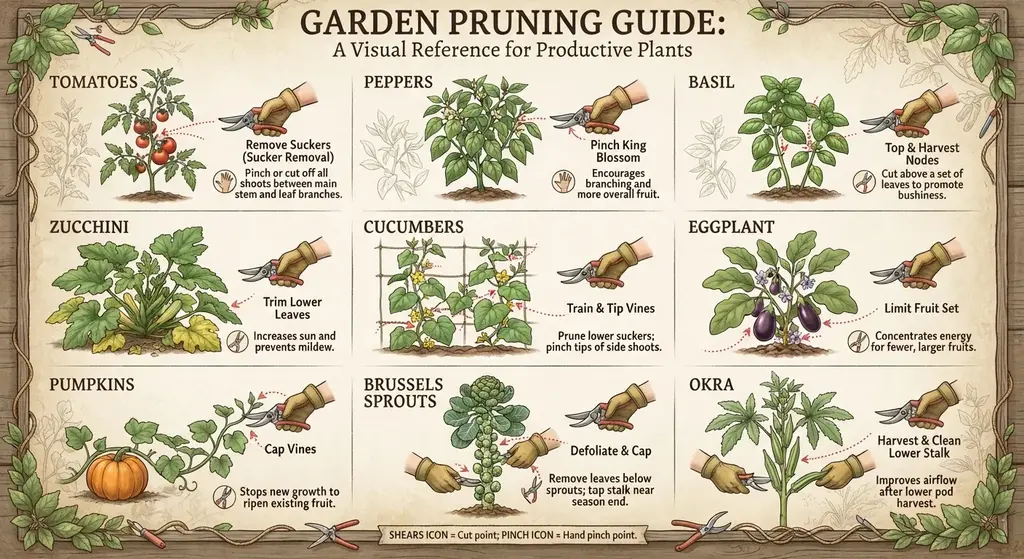
Use Clean Pruning Tools
Small soft shoots can often be pinched with clean fingers.
For larger stems, use sharp clean pruners rather than tearing the plant.
If disease is present, clean tools between plants to reduce the chance of spreading pathogens.
Prune When Leaves Are Dry
Avoid pruning wet plants whenever possible.
Bacterial and fungal diseases can spread more easily when foliage is wet, and fresh pruning wounds add another possible entry point.
Pruning Does Not Replace Proper Spacing
If your vegetable garden becomes an impenetrable wall of leaves every summer, the real problem may be spacing rather than a lack of pruning.
Giving plants enough room from the beginning improves:
- Airflow
- Light distribution
- Harvest access
- Disease monitoring
- Watering access
Pruning Does Not Replace Regular Harvesting Either
For several crops, harvesting at the correct stage has a bigger effect on continued production than pruning.
This is especially true for cucumbers, zucchini, eggplant, peppers, and okra.
Leaving overmature fruits on the plant can slow continued production, while regular harvesting encourages you to keep checking the plant and catch disease or pests early.
Pruning FAQ
Does pruning vegetables always increase yield?
No. Pruning can improve fruit size, airflow, plant management, or harvest timing in some crops, while excessive pruning can reduce total yield by removing productive stems and leaves.
Should I remove every tomato sucker?
No. The correct approach depends on whether the tomato is determinate or indeterminate, how it is supported, available space, climate, and whether you prefer larger fruit or maximum total production.
Should I remove zucchini leaves for airflow?
Remove individual diseased, damaged, dead, or badly positioned leaves when there is a clear reason. Routine heavy defoliation is unnecessary and can expose fruit to sun.
Should cucumber vines be pruned?
Specialized greenhouse systems may train cucumbers differently, but ordinary home-garden cucumbers generally do not need aggressive side-shoot pruning. Support, watering, disease management, pollination, and frequent harvesting are more important.
Should pumpkin vines be cut after fruit sets?
Not automatically. Healthy leaves continue producing energy for developing pumpkins. Trim only when vines are unmanageable, diseased, or there is another specific reason.
Does basil need pruning?
Regular stem harvesting and pinching flower buds can keep basil bushier and productive for leaves over a longer period.
Does topping Brussels sprouts help?
It can help concentrate development before a planned harvest, but topping too early may trigger unwanted new growth and reduce marketable yield.
The Bottom Line
The idea that every productive vegetable crop needs regular pruning is too simple.
Tomatoes, basil, young peppers, and Brussels sprouts can benefit from specific pruning techniques. Zucchini, cucumbers, eggplant, pumpkins, and okra generally need a much lighter touch. Keep healthy leaves whenever they are doing useful work, prune for a clear reason, and remember that sunlight captured by foliage is what ultimately powers your harvest.
Sources
- University of Vermont Extension — How to Prune Tomato Plants
- Iowa State University Extension — Pruning Tomatoes in the Home Garden
- University of Minnesota Extension — Growing Basil in Home Gardens
- University of Minnesota Extension — Growing Cucumbers in Home Gardens
- University of Minnesota Extension — Growing Eggplant in Home Gardens
- University of Maine Cooperative Extension — Trimming Vines and Leaves Before Fruit Ripens
- University of New Hampshire Extension — Brussels Sprouts Topping Study