Large planters or half-barrels can make attractive bases for outdoor string-light posts, but they should be treated as decorative light-duty supports—not as substitutes for proper pergola or structural footings.
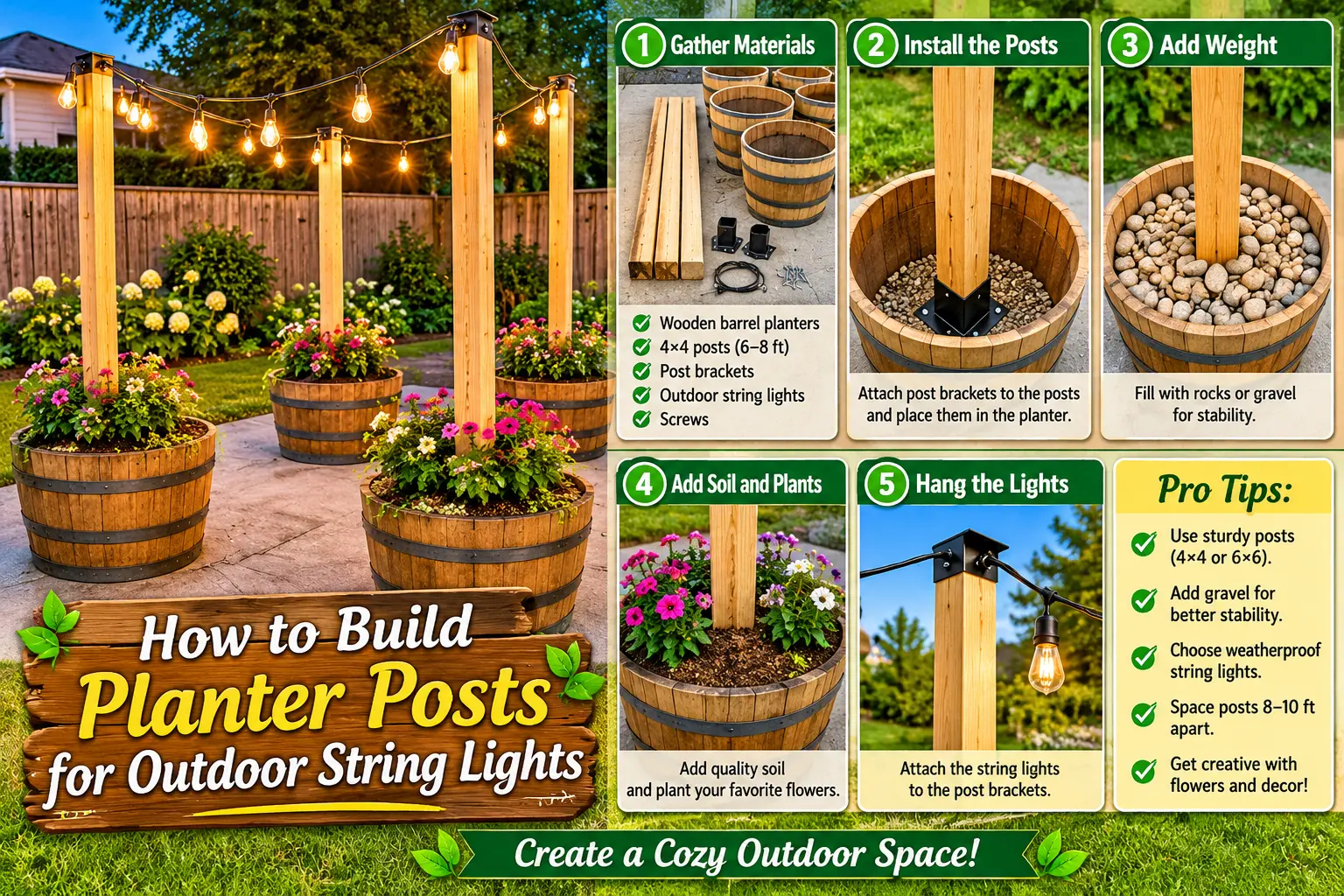
The Pinterest image shows tall wood posts fastened inside large wooden barrel planters. Once the barrels are filled with ballast and plants, this type of setup can create a clean way to support string lights around a patio, garden, or seating area without making every post look like a permanent fence post.
However, wind creates significant leverage on a tall post. The post, planter, attachment hardware, ballast, drainage, and string-light tension all matter.
Important limitation: do not use planter-mounted posts to support a pergola roof, shade sail with high tension, hammock, swing, hanging chair, heavy trellis, or any structure that could injure someone if the post tips over.
What Are Planter Posts Good For?
Planter posts work best when the load is light and mostly decorative.
Good uses can include:
- Outdoor string lights
- Very lightweight seasonal decorations
- Small garden signs
- Light climbing annuals on a modest trellis
- Defining the corners of a patio seating area
What Should Planter Posts Not Support?
Do not assume a heavy-looking barrel creates a structural foundation.
Avoid using this system for:
- Pergola beams or rafters
- Hanging swings
- Hammocks
- Hanging chairs
- Heavy shade sails
- Roof panels
- Large gates
- Anything people can climb on
Structural posts need foundations and connections designed for vertical, lateral, and uplift forces.
1. Start With a Large, Stable Container
A wide planter provides a much better base than a narrow decorative pot.
Half whiskey barrels are popular because they have:
- A broad footprint
- Substantial volume
- Enough depth for ballast and planting mix
- A natural garden appearance
But old barrels can rot, split, or loosen over time, so inspect the wood and metal bands before using one as a post base.
2. Do Not Rely on the Barrel Bottom Alone
The Pinterest image appears to show a metal post bracket fastened directly to the wooden bottom of the barrel.
That might keep the post centered, but the thin bottom boards should not be assumed to resist strong wind loads by themselves.
As the barrel ages, moisture and soil contact may weaken those boards further.
3. Use the Bracket Mainly for Alignment
A post base or bracket can help keep the post vertical while the planter is assembled.
For a movable light-duty planter post, think of the bracket as one part of the stability system—not the whole system.
4. Add Heavy Ballast Low in the Planter
Weight should be concentrated low to help resist tipping.
Possible ballast approaches include a properly formed concrete base or another dense stable material appropriate for the planter design.
Do not fill the entire barrel with concrete if you still want healthy plants. Leave adequate planting volume and drainage.
5. Keep the Center of Gravity Low
A tall post acts like a lever.
The farther the string lights are above the planter, the greater the overturning effect when wind pulls on the lights or pushes against decorations.
Using a wide planter and heavy ballast low in the container helps, but it does not make the system equivalent to a footing anchored into the ground.
6. Avoid Extremely Tall Posts
Taller is not always better.
Use only enough height to provide comfortable clearance beneath the lights while keeping the post as short as practical.
7. Use Exterior-Rated Lumber
The lower section of the post will live in a damp environment.
Choose lumber appropriate for exterior exposure and protect all cut ends according to the lumber manufacturer’s requirements.
Do not use interior framing lumber and expect it to survive years of watering and rain.
8. Keep Wood From Sitting in Constant Water
Fine Homebuilding notes that structural post-base designs often create a small standoff between wood and concrete to reduce moisture wicking into end grain.
The same moisture principle matters inside a planter: do not create a permanent puddle around the end of the post.
9. Drainage Is Essential
A barrel used as a planter needs drainage holes.
Without drainage:
- Plant roots may rot
- Wooden barrels deteriorate faster
- Post ends remain wet
- Standing water may attract mosquitoes
- Freeze-thaw damage can worsen in cold climates
10. Do Not Block Drainage With Concrete
If ballast is added, plan drainage before pouring or placing it.
The planting portion still needs a route for excess irrigation and rainwater to escape.
11. Separate Planting Mix From Structural Ballast
A useful planter post can have two functional zones:
Lower zone: stability and ballast → Upper zone: drainage + potting mix + plants
Keep enough soil volume for the plants you intend to grow.
12. Choose Plants With Modest Root Systems
Once the post and ballast occupy part of the barrel, there is less root space than a normal half-barrel planter provides.
Good candidates can include compact annual flowers and herbs suited to your climate and sun exposure.
Avoid planting a vigorous woody shrub if the remaining soil volume is too small.
13. Use the Right Potting Mix
Do not fill the planting section with dense native garden soil alone.
Use an appropriate container mix that drains while retaining enough moisture for the selected plants.
14. Expect the Planter to Become Very Heavy
Ballast, wet potting mix, the barrel, plants, and the wood post can create a very heavy finished assembly.
Move the empty planter into its final location before filling it.
15. Be Careful on Elevated Decks
Several heavily ballasted barrel planters can add substantial concentrated weight to a deck.
Do not assume an existing deck can safely carry any number of large concrete-filled planters wherever you place them.
16. Do Not Tension String Lights Like Structural Cable
One of the easiest ways to pull planter posts inward is to stretch the lights too tightly between them.
Allow appropriate sag and follow the light manufacturer’s support instructions.
The goal is to support the lights, not create a tight cable between freestanding posts.
17. Long Spans Increase the Pull on the Posts
The farther apart the planters are, the more difficult it becomes to control sag without adding tension.
Use additional support points rather than trying to stretch one long string of lights between two movable planters.
18. Wind Changes Everything
The biggest weakness of a planter post is lateral loading.
Strong wind can pull on:
- String lights
- Hanging decorations
- Vines
- Flags
- Shade fabric
- The post itself
A planter that feels solid on a calm day can behave very differently during a storm.
19. Never Add a Shade Sail Just Because the Posts Look Strong
Shade sails can generate large tension and wind forces.
They need properly engineered attachment points and should not be attached to decorative planter posts unless the entire support system was designed for those loads.
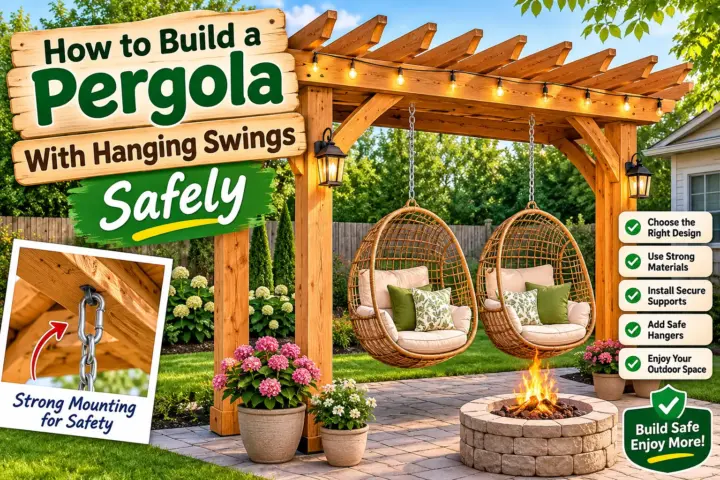
20. Do Not Turn Planter Posts Into a Swing Frame
FarmSolo’s existing pergola-with-swings guide explains why human suspension loads are different from decorative loads.
Swinging creates dynamic forces, so hanging chairs and swings belong on a structure with real footings, properly sized beams, rated hardware, and adequate bracing—not barrel planters.
21. Real Pergola Posts Need Real Foundations
When a post becomes part of a permanent structure, change construction methods.
AWC deck guidance illustrates structural posts centered on concrete footings and restrained against lateral displacement, while professional pergola construction commonly uses concrete footings with manufactured post bases.
Footing dimensions and depth depend on the structure, soil, climate, frost conditions, wind, and applicable codes.
22. Keep Structural Posts Out of Constant Soil Contact
If a post is intended to last, moisture management is important.
Post-base systems commonly elevate structural lumber above concrete to reduce moisture absorption into the end grain.
Constantly burying untreated wood in wet planter soil works against that durability goal.
23. Use Exterior-Rated String Lights
Choose lights specifically rated for outdoor use.
Keep plugs and connectors positioned according to manufacturer instructions and away from places where irrigation water pools.
24. Route Cords Away From Walkways
A planter post often sits at the edge of a patio, which makes it tempting to run an extension cord across the ground.
Do not create trip hazards across doorways, garden paths, or seating entrances.
25. Keep Electrical Connections Away From Irrigation
Watering the planter should not soak plugs, extension connections, transformers, or electrical controls.
Plan the electrical side and the irrigation side as separate zones.
26. Check the Posts After Storms
Inspect planter posts regularly for:
- Leaning
- Loose fasteners
- Cracked barrel boards
- Loose metal hoops
- Rot at the bottom of the post
- Settled ballast
- Frayed light-support wires
27. Expect Wooden Barrels to Age
A whiskey barrel planter is not permanent masonry.
Sun, rain, irrigation, wet soil, and repeated drying can eventually damage the staves and bottom.
Plan for inspection and eventual replacement.
28. Consider a Permanent Footing With a Decorative Planter Around It
If you love the appearance of barrel posts but want a permanent structure, there is another approach.
The structural post can be independently anchored to an appropriately designed footing, while the planter acts only as a decorative surround.
That separates the plant container from the job of resisting wind and structural loads.
Best permanent concept: structural footing → anchored post → decorative planter around post → plants + string lights
29. A Ground-Anchored Post Is Better for Long-Term String Lights
If you know the lights will remain in the same location for many years, permanent footings may ultimately be simpler and safer than maintaining several movable barrel bases.
You can still place flowers or decorative containers around each post to preserve the garden look.
30. Use Barrel Posts Where Their Advantages Matter
The main advantages are aesthetics and avoiding a visually bare post base—not structural performance.
They work best for a sheltered patio where:
- The string-light spans are modest
- The lights are not pulled tight
- The site is not extremely exposed to wind
- No shade sail or suspended seating is attached
- The finished planters can remain in place
A Practical Build Concept
- Choose large, sound outdoor planters or half-barrels.
- Set every container in its final location.
- Mark and center the posts.
- Install an appropriate centering/support system.
- Add low ballast appropriate for the design.
- Preserve required drainage paths.
- Keep sufficient soil depth for plants.
- Add exterior container mix.
- Plant compact flowers or herbs.
- Install exterior-rated string lights with appropriate sag.
- Avoid high-tension cables and heavy hanging items.
- Inspect the posts and containers after strong wind.
What This Pinterest Idea Gets Right
- Uses wide containers around tall posts.
- Keeps the posts centered.
- Combines structure with garden planting space.
- Hides unattractive post bases.
- Creates movable-looking patio light supports.
- Fits well in a garden or backyard setting.
What I Would Change Before Copying It
- Do not rely only on screws into the barrel floor to resist wind.
- Add low ballast while preserving drainage and planting space.
- Use exterior-rated posts and corrosion-resistant hardware.
- Keep the post base from sitting in standing water.
- Do not tension string lights excessively.
- Never attach swings, hammocks, roofs, or shade sails to this type of decorative support.
- Use real footings if the project becomes a permanent pergola.
Planter Post FAQ
Can I put a 4×4 post inside a whiskey barrel planter?
Yes for appropriately designed light-duty applications such as string lights, but the container must be stable and the post should not be treated as a structural pergola support simply because it is inside a heavy barrel.
Do I need concrete in a planter post?
Some DIY designs use concrete as low ballast, but the amount and configuration depend on the planter and intended load. Concrete can make the planter extremely heavy and may interfere with drainage if poorly planned.
Can planter posts hold string lights?
They can support lightweight outdoor string lights when the posts are stable, spans are reasonable, and the strings are not highly tensioned. Wind exposure must also be considered.
Can I attach a shade sail to planter posts?
Not to ordinary decorative planter posts. Shade sails can generate substantial wind and tension loads and require structural supports designed and anchored for those forces.
Can planter posts be used for a pergola?
A real pergola should have posts and foundations designed for its structural loads. A decorative planter can surround a structural post, but the planter itself should not be assumed to replace the footing.
What can I plant around string-light posts?
Choose compact flowers or herbs suited to your climate, sun exposure, and remaining soil volume. Avoid very large woody plants when much of the container is occupied by the post and ballast.
The Bottom Line
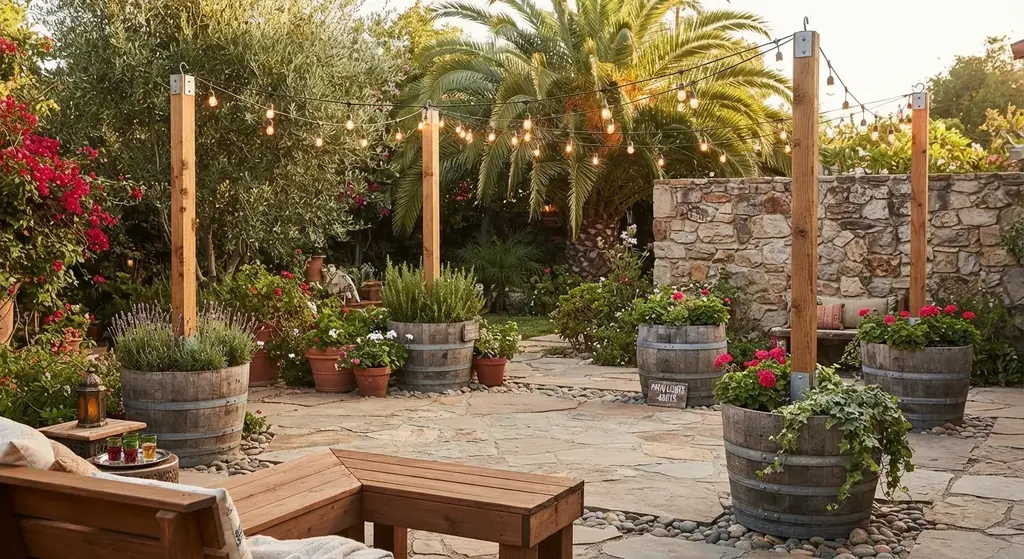
Barrel planter posts are a clever way to combine patio lighting with plants, and the Pinterest image gives a useful visual starting point.
Just keep the project in the light-duty category. Use wide stable containers, add ballast low, preserve drainage, protect the wood from constant moisture, avoid excessive cable tension, and switch to proper concrete footings whenever the posts will support a pergola, shade sail, swing, roof, or another structural load.
Sources
- American Wood Council — Prescriptive Residential Wood Deck Construction Guide
- Fine Homebuilding — How to Lay Out Post Bases for a Pergola
- Fine Homebuilding — Options for Fastening Deck Posts to Footings