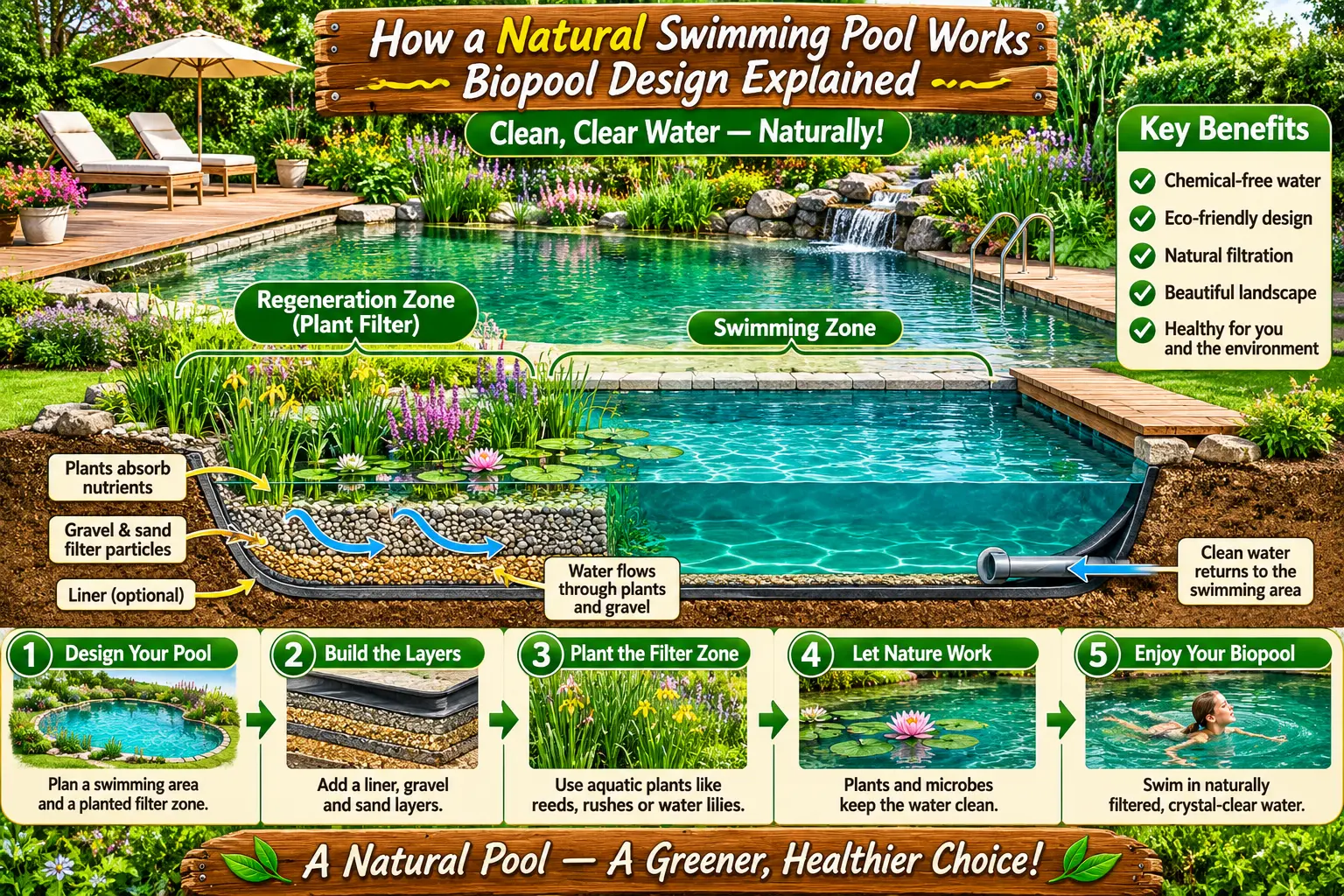
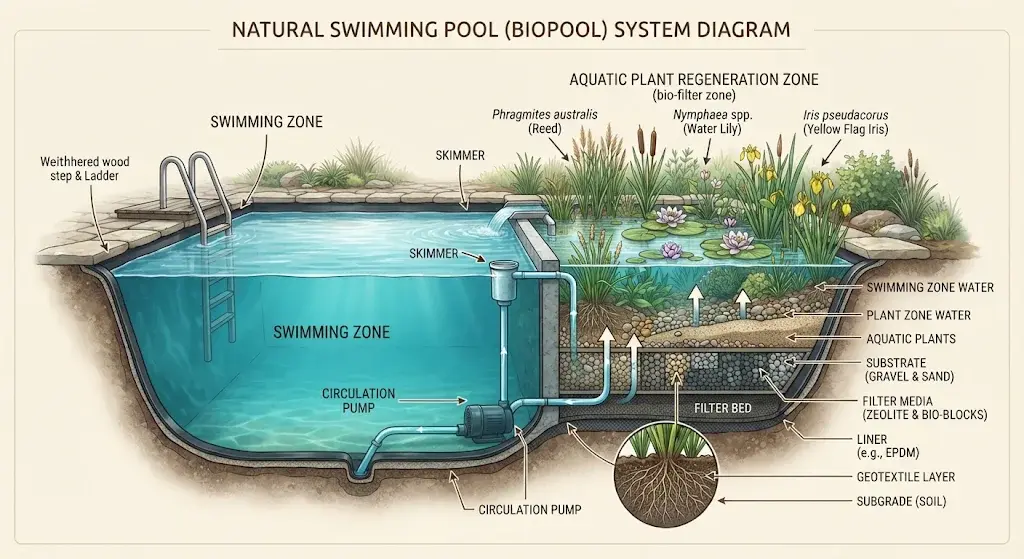
A natural swimming pool, often called a biopool or swimming pond, separates the main swimming area from a biological regeneration zone filled with suitable plants and filtration media. Water circulates between the two zones so particles, nutrients, and organic material can be managed without designing the system like a conventional chlorinated backyard pool.
The Pinterest diagram captures the basic idea well: a swimming zone, planted regeneration beds, waterproof liner, substrate layers, circulation plumbing, and a deck. What it oversimplifies is the phrase “the pool cleans itself.” A natural pool still needs correct sizing, circulation, debris removal, water monitoring, plant management, and periodic maintenance.
Important: “natural” does not mean automatically pathogen-free. Conventional pools use disinfectants such as chlorine specifically to control germs. A natural swimming system therefore needs to be designed for recreational-water safety and must comply with any applicable local pool, building, electrical, fencing, and public-health requirements.
What Is a Natural Swimming Pool?
A natural swimming pool is a purpose-built body of water designed for swimming while using biological and physical filtration as major parts of the water-treatment system.
Unlike a decorative pond, it needs to be designed around swimmers. Unlike a conventional pool, it may use a planted regeneration area instead of relying primarily on chlorine or bromine.
A typical system includes:
- A swimming zone
- A regeneration or planted filtration zone
- A waterproof liner or structural shell
- Pumps and circulation plumbing
- Mineral or gravel filtration media
- Skimming or mechanical debris removal
- Overflow and drainage management
1. The Swimming Zone
The swimming zone is the open-water area intended for people.
The Pinterest design keeps most aquatic vegetation around the edges rather than filling the central swimming area. That makes sense because swimmers need clear access and water circulation should not be blocked by dense vegetation.
2. The Regeneration Zone
The regeneration zone is the planted portion of the pool system.
It may contain aquatic plants growing in gravel or another engineered substrate. Water is moved through or alongside this zone so nutrients and suspended material can be managed biologically and physically.
This area should not be treated as ordinary garden soil dropped into a swimming pool. The substrate, water depth, circulation rate, and plants need to be selected for the specific system.
3. Aquatic Plants Are Part of the System
Aquatic plants can take up nutrients while also providing surfaces for beneficial microbial communities.
The plant list should be based on:
- Climate
- Winter temperature
- Water depth
- Sun exposure
- Plant invasiveness
- Local regulations
- The filtration design
Avoid copying aquatic plants from a Pinterest image without checking whether they are invasive or appropriate where you live.
4. The Pool Still Needs Circulation
A natural pool is not simply a hole filled with water and plants.
Water needs to move between the swimming zone and treatment areas. A pump is commonly used to maintain circulation and move water through filtration components.
Poor circulation can create stagnant areas where debris and nutrients accumulate.
5. Mechanical Filtration Still Matters
Plants should not be expected to remove every leaf, insect, hair, piece of soil, or floating particle.
Depending on the system, mechanical components may include:
- Skimmers
- Pump baskets
- Prefilters
- Settlement areas
- Gravel filtration zones
- Specialized biological filters
6. Substrate Is More Than Decoration
The Pinterest graphic shows a sand or pond-substrate layer beneath the regeneration zone.
In a real project, the filtration media must be selected carefully. Ordinary fertile topsoil can release nutrients into the water and encourage unwanted algae growth.
Follow the engineered design rather than improvising the filtration bed with garden soil.
7. A Waterproof Liner Keeps Water Where It Belongs
The liner shown in the diagram is one of the most important structural components.
A liner or engineered watertight shell prevents the pool from continuously leaking into surrounding soil.
The liner normally needs protection from:
- Sharp stones
- Tree roots
- Settlement
- Construction damage
- UV exposure where applicable
8. Geotextile Protects and Separates Layers
Geotextile fabric may be used beneath or around liner systems to reduce puncture risk and keep different structural or filtration layers separated.
It is not a substitute for a waterproof liner.
9. “No Chlorine” Does Not Mean “No Water Management”
The strongest claim in the Pinterest graphic is also the one that needs the most context.
CDC explains that in conventional swimming pools, properly maintained chlorine or bromine and pH are the first line of defense against many germs that cause swimming-related illness.
A natural swimming pool uses a different treatment strategy, so the absence of conventional chlorination should never be interpreted as proof that the water is automatically safe to drink or free from pathogens.
10. Water Quality Still Needs Monitoring
Clear water is not automatically microbiologically safe water.
Natural swimming pools may require monitoring appropriate to the design and local regulations, especially where the pool is used frequently or by the public.
A planning review for a natural swimming pool in the United Kingdom specifically identified water hygiene as an issue to be monitored by Public Health, illustrating why biological appearance alone is not enough.
11. Keep Runoff Out of the Pool
Rainwater flowing across lawns and garden beds can carry soil, fertilizer, manure, pet waste, pesticides, and other contaminants into water.
Grade the surrounding landscape so dirty surface runoff does not wash directly into the swimming zone.
12. Avoid Fertilizing Beside the Regeneration Zone
Extra nutrients can encourage algae and upset the low-nutrient balance that many natural-pool designs try to maintain.
Do not treat aquatic planting beds like ordinary flower beds that need routine fertilizer.
13. Plan Overflow Before Construction
Heavy rain can raise the water level quickly.
Provide a controlled overflow route that will not:
- Erode the pool edge
- Flood a building
- Damage neighboring property
- Undermine retaining walls
- Send contaminated water toward a well
14. Keep the Pool Away From Septic and Contamination Sources
Site planning should consider septic systems, drainage fields, wells, livestock areas, compost, manure storage, and other potential sources of contamination.
Local setback rules may apply.
15. A Natural Pool Is Not the Same as a Wildlife Pond
Both may contain plants and look natural, but their management goals differ.
A wildlife pond may intentionally attract frogs, waterfowl, and other animals. A swimming pool needs more control over contamination and safe human access.
Do not intentionally encourage ducks or geese to use the swimming area. Their droppings add substantial nutrients and microorganisms to the water.
16. The Deck Needs Its Own Safety Plan
The timber deck shown in the Pinterest image creates a beautiful transition into the water, but wet decking can become slippery.
Choose materials suitable for repeated wet exposure, provide secure edges, and avoid creating hidden trip hazards where the deck meets stone or planting areas.
17. Entry and Exit Points Must Be Obvious
A pool that looks like a pond still needs safe ways to get in and out.
Depending on the design, that may include:
- Steps
- Ladders
- A shallow beach-style entry
- Handrails
- Clearly defined swimming edges
18. Children Still Need Pool-Level Protection
Calling it a pond does not remove the drowning risk.
CDC recommends four-sided fencing that fully separates backyard pools from the house, with self-closing and self-latching gates, to help prevent unsupervised child access.
19. Pumps and Electricity Need Professional Attention
Natural pools may use circulation pumps, skimmers, underwater equipment, lighting, controllers, or other powered components.
Electrical work around swimming water is a high-risk area. Use equipment approved for the intended aquatic installation and follow local electrical codes and inspection requirements.
20. The Regeneration Zone Needs Maintenance
A planted filtration bed changes through the seasons.
Maintenance may include:
- Removing dead foliage
- Dividing aggressive plants
- Removing accumulated organic debris
- Cleaning skimmers and pump baskets
- Inspecting circulation
- Managing algae
- Checking water level
- Inspecting liner edges
21. Autumn Leaves Can Become a Major Nutrient Load
A pool surrounded by mature trees looks beautiful, but falling leaves break down and release nutrients into the water.
Regular skimming or seasonal netting may be useful where leaf fall is heavy.
22. Algae Does Not Automatically Mean the Pool Has Failed
Natural water systems do not always look like a sterile blue conventional pool.
Some biological growth may occur, especially while a new system is establishing. Persistent excessive algae, however, can indicate too many nutrients, inadequate circulation, an undersized treatment area, or another imbalance.
23. Do Not Copy the Pinterest Dimensions
The illustration is conceptual. It does not provide enough information to calculate pool volume, regeneration-zone size, pump flow, pipe diameter, filtration capacity, structural loads, or safe swimming depths.
Use it as inspiration, not as a construction plan.
24. Local Rules May Treat It as a Swimming Pool
A natural appearance does not necessarily exempt the project from pool regulations.
Depending on location, permits may apply to:
- Excavation
- Swimming pools
- Fencing
- Electrical work
- Deck construction
- Drainage
- Groundwater protection
- Setbacks
Natural Pool vs. Conventional Pool
| Feature | Natural Swimming Pool | Conventional Pool |
|---|---|---|
| Main treatment concept | Biological and physical filtration | Filtration plus disinfectant such as chlorine or bromine |
| Plants | Often part of the treatment system | Usually outside the water |
| Appearance | Pond-like or naturalistic | Typically engineered pool appearance |
| Maintenance | Plant, biological, circulation and debris management | Disinfectant, pH, filtration and debris management |
| Safety rules | Local pool/pond rules may apply | Pool codes normally apply |
What This Pinterest Biopool Diagram Gets Right
- Separates swimming and regeneration zones.
- Shows continuous circulation between areas.
- Uses aquatic planting as part of the system.
- Includes a waterproof liner.
- Shows substrate and geotextile layers.
- Integrates the pool into the surrounding landscape.
- Includes a dedicated deck and swimming access area.
What I Would Correct
- Replace “chemical-free water” with “a system designed to reduce or avoid conventional pool disinfectants, depending on the design and local requirements.”
- Replace “cleans itself” with “uses biological and physical filtration but still requires maintenance.”
- Add mechanical filtration and debris-management details.
- Add water-quality monitoring.
- Add safe overflow and stormwater planning.
- Add fencing and drowning-prevention requirements.
- Add electrical and pump safety.
- Do not use a conceptual Pinterest cross-section as an engineering plan.
Natural Swimming Pool FAQ
Can a swimming pool really work without chlorine?
Purpose-built natural swimming pools can be designed around biological and physical treatment rather than a conventional chlorination system. That does not mean untreated water is automatically safe. Design, circulation, filtration, monitoring, maintenance, and local requirements still matter.
Do natural swimming pools clean themselves?
Not literally. Biological processes help treat the water, but owners still need to remove debris, manage plants, maintain pumps and filters, inspect the liner, and monitor the system.
Do natural pools attract mosquitoes?
Good circulation reduces stagnant zones where mosquitoes prefer to breed, but any standing-water feature can develop mosquito problems if circulation stops or isolated stagnant pockets form.
Can fish live in a natural swimming pool?
Adding fish changes nutrient loading, filtration requirements, and water management. A swimming biopool should not automatically be managed like an ornamental koi pond.
How large should the regeneration zone be?
There is no safe universal percentage to copy from a Pinterest diagram. Required area depends on pool volume, treatment technology, climate, plant system, swimmer load, circulation, and the design standard being used.
Can I convert an existing pool into a natural pool?
Sometimes, but conversion may require additional biological filtration space, plumbing changes, circulation redesign, waterproofing work, and structural review. It is a design project rather than simply stopping chlorine use.
Is a natural pool maintenance-free?
No. The type of maintenance changes, but maintenance does not disappear.
The Bottom Line
The Pinterest concept shows the basic anatomy of a natural swimming pool well: a clear swimming area connected to a planted regeneration zone over engineered substrate and a waterproof liner.
The part to avoid copying is the idea that a biopool simply “cleans itself.” A successful natural swimming pool is an engineered water system. It still needs circulation, filtration, water-quality management, debris removal, plant care, safe access, electrical protection, drainage planning, and compliance with local swimming-pool requirements.
Sources
- CDC — Home Pool and Hot Tub Water Treatment and Testing
- CDC — Guidelines for Keeping Your Pool Safe and Healthy
- CDC — Pool Chemical Safety
- Local planning and public-health documentation for natural swimming pool projects