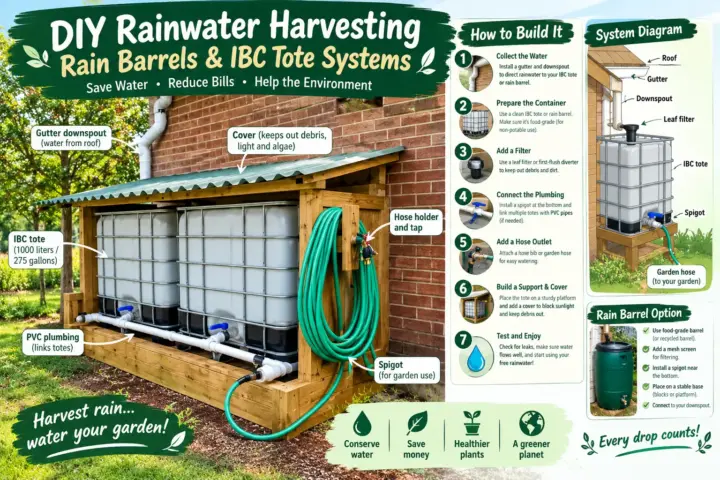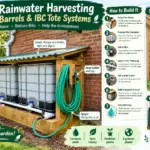
EXPANDING THE SYSTEM • MULTIPLE RAIN BARRELS
How to Connect Multiple Rain Barrels
One rain barrel can fill surprisingly fast. If your garden regularly uses more stored water than a single barrel provides, linking several barrels can increase capacity without moving to one large tank.
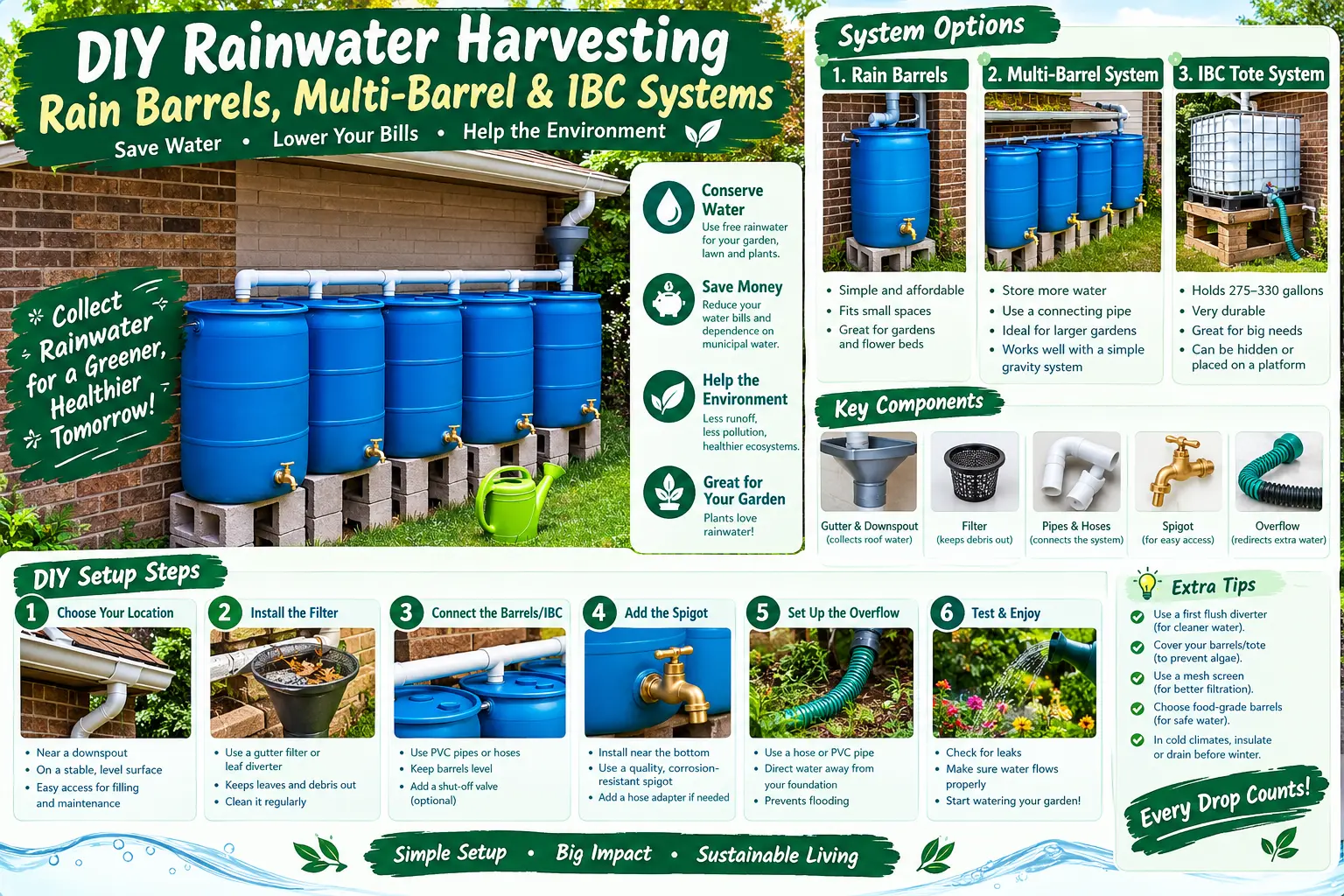
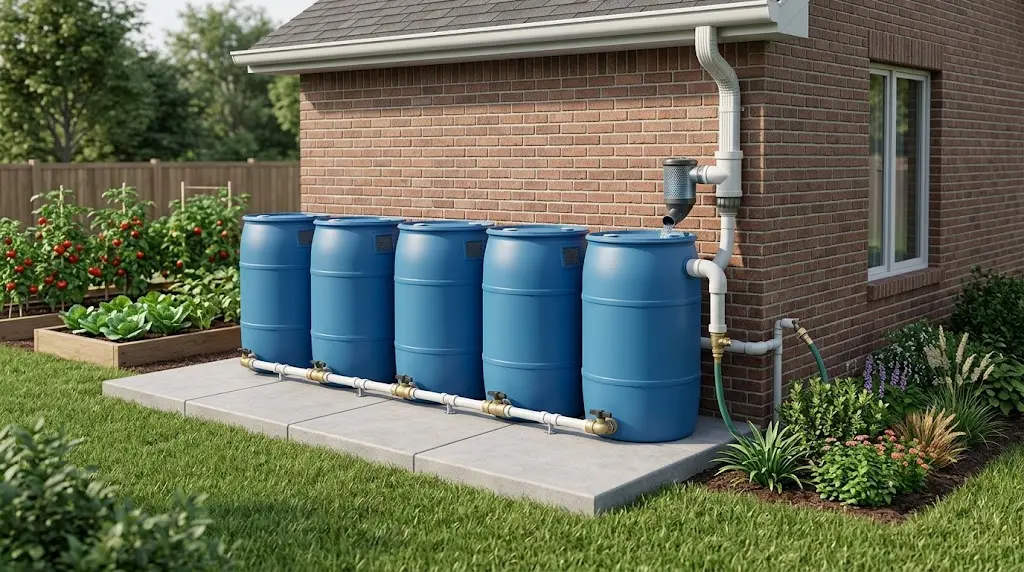
The Pinterest setup shows five barrels beneath one gutter with plumbing across the top and individual faucets near the bottom. The idea is useful, but the way the barrels are linked determines how they fill, drain, overflow, and behave during a heavy storm.
5 × 55-Gallon Barrels
Five typical 55-gallon barrels can store about 275 gallons of water when completely full.
More Than 2,300 lb of Water
Water alone in five full 55-gallon barrels weighs roughly 2,300 pounds, before adding the barrels, plumbing, or stands.
How Fast Can Five Barrels Fill?
One inch of rain falling on one square foot of roof produces about 0.623 gallons of potential runoff before system losses.
That means just 500 square feet of roof can produce roughly 311 gallons from a one-inch rain in theory. A five-barrel system holding about 275 gallons can therefore fill much faster than many homeowners expect.
Roof area × rainfall in inches × 0.623 = approximate gallons before losses
8 Things to Plan Before Linking Rain Barrels
01 • BASE
Build for the Weight of Full Barrels
A full 55-gallon barrel weighs more than 450 pounds. Five full barrels place well over a ton of water on a fairly small part of the yard.
Use a firm, level and stable base that will not sink unevenly after rain. Concrete blocks or pavers can be part of a good stand, but do not blindly copy narrow or unstable stacks simply because they appear in a photo.
02 • CONNECTION HEIGHT
Choose Between Top Linking and Bottom Linking
Top connections can pass overflow from one barrel to another. This is simple, but once the water level falls below the connection, the remaining water stays in each individual barrel.
Bottom connections allow water levels in matching barrels at the same elevation to equalize. That can make several barrels behave more like one larger storage tank.
03 • LEVEL
Keep Bottom-Linked Barrels at the Same Height
If the barrels are connected low so their water levels equalize, their bases should be carefully leveled. One barrel sitting noticeably lower than the others changes the usable capacity and how the system behaves.
04 • INLET
Screen the Water Before It Enters Five Barrels
A larger storage system makes gutter maintenance and debris control even more important. Leaves and roof dirt that enter one barrel can become sediment you eventually have to remove from the entire system.
Use a suitable inlet screen and consider a first-flush diverter so the dirtiest initial roof runoff is directed away from storage.
05 • VENTING
Let Air Move as Water Enters and Leaves
Covered atmospheric barrels need an appropriate way for air to move as water levels rise and fall. Keep vents protected from mosquitoes and debris instead of simply leaving large openings exposed.
06 • OVERFLOW
The Last Barrel Still Needs a Real Overflow
Adding more barrels delays overflow. It does not eliminate it.
Once every container is full, roof runoff still needs a safe path away from the building. Use an adequately sized overflow and direct the discharge toward an appropriate landscape or drainage area rather than letting water pool beside the foundation.
07 • WATER PRESSURE
Raising the Barrel Helps, but Gravity Pressure Is Still Low
Elevating a rain barrel makes it easier to fit a watering can under the faucet and adds a little gravity pressure. Roughly speaking, every foot of water elevation gives only about 0.4 psi.
Do not build an unusually tall or unstable stand simply because you want household-style hose pressure. If stronger pressure is necessary, a properly designed pump is usually the better solution.
08 • MAINTENANCE
Make Every Barrel Serviceable
More storage also means more fittings, more sediment, and more places to inspect for leaks.
Do not permanently hide the connectors behind an enclosure. Leave enough access to clean screens, disconnect plumbing, flush sediment, repair a valve, and remove one barrel without dismantling the entire system.
Top-Linked vs. Bottom-Linked Rain Barrels
| Design | How it works | Best to know |
|---|---|---|
| Top / overflow connection | One barrel fills until water reaches the high connection and then sends excess to another barrel. | Water below the connection remains in that barrel, so individual outlets are useful. |
| Bottom connection | Water can move between the barrels and the levels equalize when the barrels are installed at the same height. | Can allow the group to behave more like one storage system and use a shared outlet. |
| Top distribution manifold | One downspout branches to several individual barrel inlets. | Each barrel still needs proper venting, overflow planning, and a way to drain its stored water. |
What I would change from the Pinterest setup: I would not copy the barrel stands or plumbing dimensions directly from the image. I would first prepare one wide, level load-bearing area, decide whether the barrels should equalize through low connections or fill in sequence, add screened vents and a clear overflow route, and only then choose the final pipe layout.
A Better Multi-Barrel Flow
Roof → gutter → debris screen → first flush → barrel system → screened vents → usable outlet → safe overflow.
Adding five barrels should increase storage capacity without making the water path difficult to understand or repair.
Related FarmSolo guides: For valves, outlets and gravity-fed plumbing, see DIY Water Tank Plumbing. For atmospheric tank venting, see Water Tank Vent Pipe.