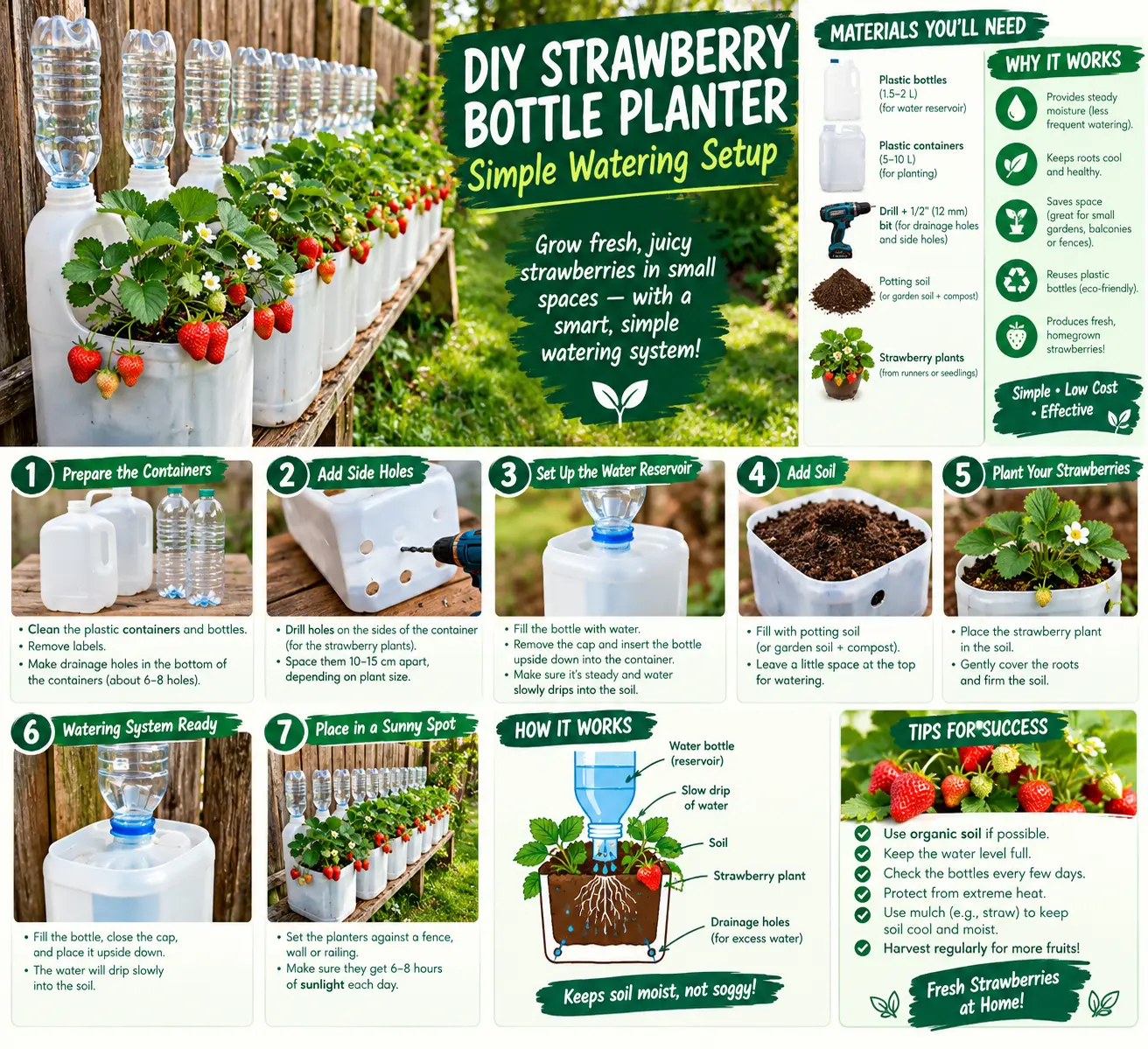
A DIY strawberry bottle planter can be a useful small-space project, but the container and watering setup matter more than the Pinterest look. Use food-safe containers large enough for the roots, provide drainage, keep the strawberry crown at soil level, and treat an inverted bottle as a slow-drip watering aid rather than a guaranteed self-watering system.
Before you build it
- Use only food-safe plastic containers that never held chemicals.
- Choose the largest practical container instead of a tiny bottle.
- Add drainage holes before adding potting mix.
- Keep the strawberry crown level with the soil surface.
- Use the inverted bottle for controlled slow watering, not constant saturation.

What Is This Strawberry Bottle Planter Idea?
The inspiration image shows strawberry plants growing in individual plastic containers lined up along a fence. Each planter also has an inverted clear bottle positioned near the soil.
The basic idea combines two simple garden tricks: repurposing a larger container as a strawberry pot and using a smaller bottle to release water slowly near the roots.
This can work in a patio, balcony, side yard, or narrow strip where a full garden bed would take up too much space.
But the exact containers in a Pinterest image should not be copied blindly. Container size, previous contents, plastic type, drainage, and outdoor durability all matter when you are growing something you plan to eat.
Food-safety rule: Do not turn old detergent, cleaning-product, paint, pesticide, adhesive, or chemical containers into strawberry planters. Use new food-grade containers or clean containers that previously held food.
Is This Really a Self-Watering Strawberry Planter?
Not necessarily.
A true self-watering container normally has a water reservoir below the growing medium. Water moves from that reservoir into the root zone through a wick, soil column, or similar system, and an overflow opening prevents the reservoir from filling too high.
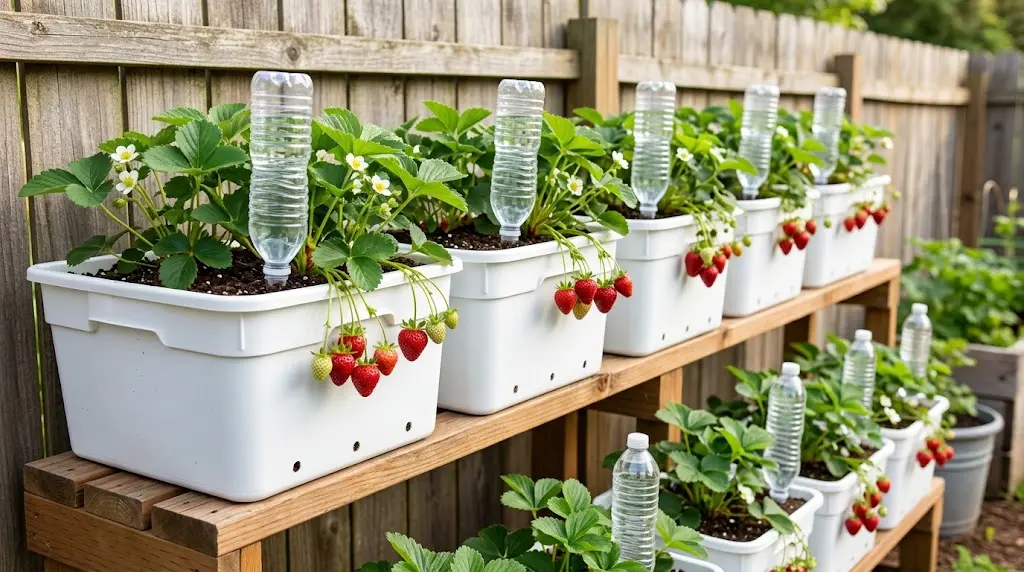
An upside-down bottle pushed into the soil works differently.
If the cap or neck has a very small opening, water can slowly move into the surrounding potting mix. That makes it a simple slow-drip watering bottle.
If the opening is too large, the bottle may empty quickly. If it is too small, soil can clog it. And if the container already stays wet, continuously adding water can make the root zone too saturated.
So the bottle should help you manage moisture, not replace checking the potting mix.
What Size Container Do Strawberries Need?
Strawberries have relatively shallow roots, which makes them well suited to containers, but that does not mean the smallest bottle is the best planter.
Iowa State University Extension recommends containers around 12 inches in diameter and at least 8 inches deep as a useful minimum starting point. Oregon State gives similar guidance and recommends larger containers when several plants share the same pot.
A larger container also holds moisture more evenly than a very small bottle exposed to summer sun.
If you want the recycled-container look from the photo, use the largest suitable food-safe jug you can practically fit in the space and avoid crowding several strawberry plants into a tiny root volume.
How to Make a DIY Strawberry Bottle Planter
1. Choose a Food-Safe Container
Use a food-grade plastic jug, bucket, or planter that is large enough for the strawberry roots.
University of Maryland Extension recommends looking for containers marked food-grade or intended for food storage. It also advises against using containers that previously held detergents, paints, adhesives, or other chemicals.
For repurposed plastic, HDPE, LDPE, and polypropylene are commonly used food-safe choices when the original container was intended for food.
2. Cut a Wide Planting Opening
Cut the upper section of the container so you have enough room to add potting mix, position the strawberry correctly, and inspect the soil later.
A narrow opening may look tidy, but it makes planting, pruning runners, adding fertilizer, and checking the crown unnecessarily difficult.
Smooth or cover sharp cut edges before handling the planter regularly.
3. Add Drainage Holes
Container strawberries need consistent moisture, but the potting mix should not remain waterlogged.
Add several drainage holes near the bottom so excess water can leave the planter.
Do not assume the inverted watering bottle replaces drainage. These two features do opposite jobs: one adds water slowly, while the other lets excess water escape.
4. Fill With Potting Mix
Use a quality all-purpose potting mix designed for containers rather than digging dense soil from the yard and packing it into the jug.
Container mixes are designed to hold moisture while still maintaining pore space for roots.
If the mix already contains starter fertilizer, follow its label before adding anything else.
5. Plant the Strawberry at the Correct Depth
The strawberry crown is the short central section where the leaves and roots meet.
Keep the crown level with the soil surface. Do not bury it deeply, and do not leave the roots exposed above the mix.
Incorrect planting depth can cause poor establishment or crown problems.
6. Add the Slow-Drip Bottle
Use a clean food-safe water bottle with a small hole in the cap or another controlled outlet near the neck.
Insert it close enough to wet the root zone without damaging the crown or major roots.
Fill it with plain water and watch how quickly it empties.
If the bottle empties almost immediately, the opening is too large for slow watering. If no water moves, check for a clogged opening.
7. Put the Planter in Full Sun
Container strawberries need plenty of sunlight to flower and produce fruit well.
Iowa State recommends at least six hours of direct sunlight per day for container-grown strawberries.
A sunny fence can be useful, but check whether the fence itself shades the plants during part of the day.
Also remember that containers heat up faster than garden soil. A hot west-facing fence can create much warmer root conditions than the same planter in a more open location.
Best Strawberry Types for Containers
Day-neutral and everbearing strawberries are especially useful for container growing because they can produce fruit during the first growing season.
Iowa State lists day-neutral varieties such as Albion, Cabrillo, Everest, and Seascape as container options and also recommends Ozark Beauty as an everbearing choice.
The best cultivar still depends on your climate, local availability, disease pressure, and growing season.
If you are buying plants locally, ask which day-neutral or container-friendly varieties perform well in your region rather than ordering only by berry size or online photos.
How Often Should You Refill the Water Bottle?
Do not refill it on a fixed schedule without checking the soil.
Strawberries have shallow roots and do not tolerate drying out well, especially in containers. At the same time, continuously saturated potting mix can cause root problems.
Check the potting mix regularly. When the surface begins to dry, water as needed and confirm that excess water can drain from the bottom.
During hot weather, small containers can need attention daily. Larger planters generally buffer moisture changes better than tiny bottles.
If the bottle stays full for days while the surrounding mix is dry, the outlet is probably not distributing water correctly.
Slow-Drip Bottle vs. True Self-Watering Container
| Setup | How it works | Main limitation |
|---|---|---|
| Inverted bottle | Releases water slowly near the root zone | Flow can vary or clog |
| True self-watering planter | Roots or potting mix wick water from a lower reservoir | Needs a properly designed reservoir and overflow |
| Normal container | Water is applied from the top and drains below | May need frequent watering in hot weather |
If you want a genuine reservoir system, University of Maryland Extension has a self-watering container guide that explains the basic reservoir, separator, wicking area, and overflow design.
Do Not Crowd Too Many Plants Into One Jug
The Pinterest image makes a long row of strawberry plants look very productive, but each plant still needs enough root space, light, water, and airflow.
Iowa State suggests about 8 inches between strawberry plants in containers and notes that a 12-inch round container can often hold three or four plants.
For a much smaller recycled jug, one plant may be the more practical choice.
Do not try to maximize the number of plants if it leaves almost no potting mix around the roots.
What About Strawberry Runners?
Runners are long stems that produce daughter plants.
In a small container, allowing many runners to grow can pull energy away from fruit production because the new plantlets have nowhere to root properly.
Day-neutral and everbearing cultivars usually produce fewer runners than June-bearing types, which is another reason they work well in containers.
Remove excess runners unless you deliberately want to root a daughter plant in another container.
Can You Line Several Planters Along a Fence?
Yes, and this is one of the strongest ideas in the inspiration image.
A narrow fence line can become useful growing space without sacrificing the middle of the yard.
Before building a long row, check four things:
- Does the entire row receive enough direct sunlight?
- Can you reach every planter easily for watering and harvest?
- Can drainage water escape without rotting a wooden shelf or creating mud?
- Is the shelf or support strong enough for wet potting mix and water-filled containers?
If you are building a larger food-growing area, FarmSolo’s vegetable garden guide can help with sunlight, watering, spacing, and keeping the growing setup manageable.
Common DIY Strawberry Bottle Planter Mistakes
- Using old detergent or chemical jugs. Food crops should be grown in suitable food-safe containers.
- Using a planter that is too small. A tiny root zone dries quickly and leaves little room for healthy growth.
- Skipping drainage holes. A watering bottle does not prevent waterlogging.
- Burying the strawberry crown. Keep the crown at the soil surface.
- Assuming the bottle waters perfectly. Check the actual soil moisture and drainage.
- Keeping the soil constantly soaked. Consistent moisture does not mean permanently saturated soil.
- Putting the row in deep shade. Strawberries need substantial direct sunlight for good flowering and fruiting.
- Leaving brittle plastic outdoors indefinitely. Sun and weather can degrade plastics that were never designed for long-term outdoor use.
- Overloading a weak wooden shelf. Wet potting mix and full water bottles add more weight than empty containers suggest.
When to Replace a Plastic Planter
Repurposing a suitable food container can extend its useful life, but plastic does not last forever outdoors.
Sunlight and weather can make some plastics brittle over time.
University of Maryland Extension advises replacing containers that become cracked or degraded rather than continuing to use deteriorating plastic for edible crops.
Inspect the planter at the start of each growing season and replace it if the plastic is splitting, crumbling, or breaking around the cut edges.
Harvesting Container Strawberries
Pick strawberries when they reach the normal ripe color for the cultivar and the fruit is fully developed.
Container growing can make harvest easier because the berries hang near the edge instead of hiding in garden soil.
Check plants frequently during fruiting so ripe berries do not remain outside longer than necessary.
For a larger backyard harvest, FarmSolo’s garden harvest basket guide has simple ideas for collecting soft produce without piling everything into one deep container.
DIY Strawberry Bottle Planter FAQ
Can strawberries really grow in plastic bottles?
They can grow in suitable plastic containers, but larger containers are easier to manage than very small bottles. The container should be food-safe, have drainage, provide enough root space, and contain quality potting mix.
Can I use an old milk jug as a strawberry planter?
A clean food-grade milk jug can be repurposed, but its size may be limiting. Use the largest practical container and inspect the plastic regularly for outdoor degradation.
Can I use an old detergent jug?
No. For edible crops, avoid containers that previously held detergents, paint, pesticides, adhesives, or other chemicals, even if the plastic itself has a normally food-safe recycling code.
Does an upside-down bottle make the planter self-watering?
Not in the usual horticultural meaning of a self-watering container. It can act as a slow-drip water source if the outlet is small enough. A true self-watering container normally uses a lower reservoir and a wicking system.
How much sun do container strawberries need?
Aim for at least six hours of direct sunlight per day. Local climate matters, and containers can heat quickly in very hot locations.
How often should strawberries in containers be watered?
Check them regularly rather than using a fixed schedule. Container strawberries need consistent moisture and can require daily watering during hot weather, but excess water still needs to drain freely.
Which strawberries are best for pots?
Day-neutral and everbearing cultivars are often the easiest choices because they can fruit during the first season and generally produce fewer runners than June-bearing types.
Keep the Clever Part, Fix the Weak Parts
The Pinterest idea gets one thing very right: strawberries can turn a narrow sunny fence line into productive growing space, and a simple bottle can make watering more convenient.
But the safest and most reliable version needs a few upgrades.
Use food-safe containers, give the roots more space than a tiny bottle provides, add proper drainage, keep the crown at soil level, and test the slow-drip bottle instead of assuming it waters perfectly.
With those changes, the idea becomes more than a clever recycling photo. It becomes a practical small-space strawberry setup you can actually maintain through the growing season.