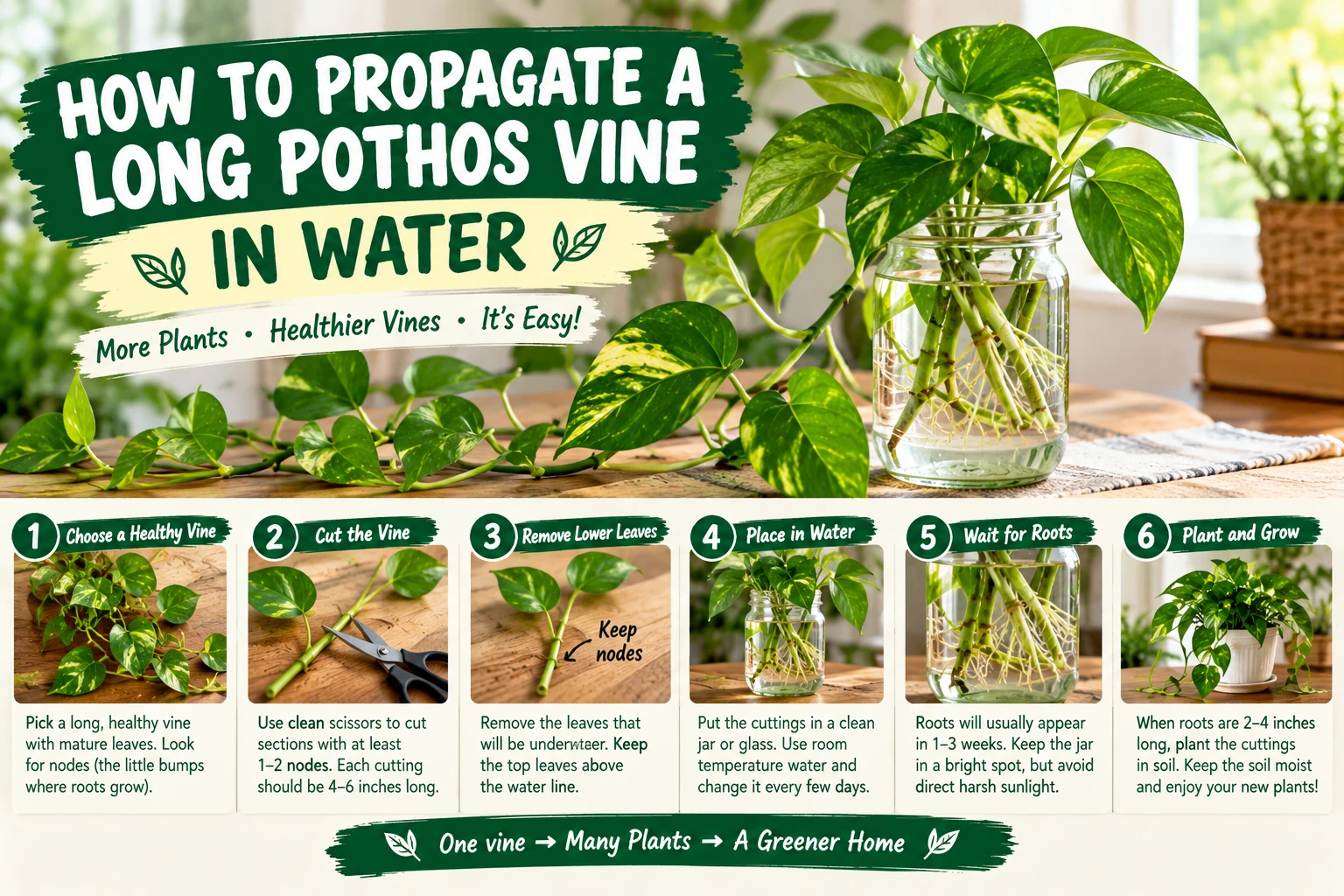
You can propagate a long pothos vine in water, but the nodes are what matter most. A flexible vine can be loosely coiled in a shallow container so several nodes contact the water, but shorter node cuttings are usually easier to manage when you want several new plants.
Quick answer
- Find the nodes along the vine before cutting anything.
- Every cutting needs at least one node.
- A long flexible vine can be loosely coiled so several nodes touch water.
- Keep the leaves above the water whenever possible.
- Use shorter node cuttings when you want several separate plants.
What Is the Pothos Bowl Propagation Method?
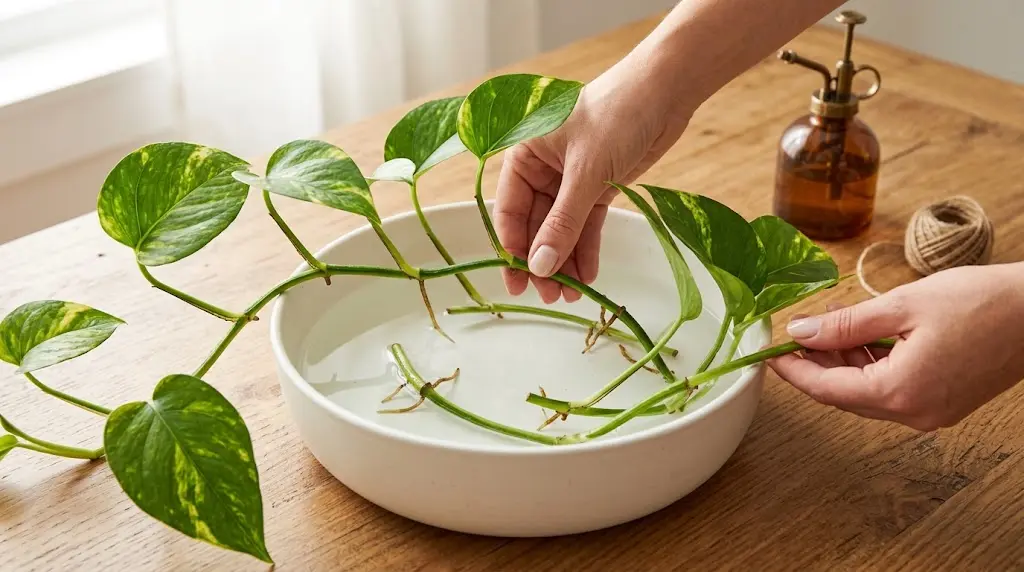
The idea shown in the inspiration image uses a long pothos vine instead of immediately cutting the stem into many small pieces.
The vine is gently arranged in a wide, shallow container. This can bring several nodes close to the water at the same time without needing a separate jar for every section.
The important part is not the circular shape. The important part is the nodes along the stem. A node is the area where a leaf joins the main vine, and you may also see a small brown aerial root or bump beside it.
University extension guidance for pothos normally describes propagation with stem cuttings that contain at least one node. The bowl method uses the same basic idea, but keeps more of the original vine together.
Can You Propagate a Whole Long Pothos Vine?
A long section of pothos vine can develop roots when healthy nodes are kept in suitable rooting conditions.
However, keeping a very long vine intact is not necessarily the easiest way to propagate the plant. Standard horticultural guidance usually uses shorter stem sections with a node and leaf because each cutting is easier to position, inspect, and transplant.
Best way to think about it: Use the bowl method when you want to keep more of a flexible vine together. Use shorter node cuttings when you want a simpler setup or several separate plants.
First, Find the Nodes on Your Pothos
This is the most important part of pothos propagation.
Follow a leaf stalk back to the main green vine. Where it meets the vine, you should see a small joint or slightly raised section. Many pothos stems also have a short brown aerial root growing from this area.
That section is the node.
Roots and new growth depend on node tissue. A leaf by itself, without a useful section of the main stem and node, is not the same as a proper pothos stem cutting.
Easy check: Follow the leaf stalk to the main vine. Preserve the joint where it attaches when making your cutting.
How to Propagate a Long Pothos Vine in Water
1. Start With a Healthy Vine
Choose a firm green section with healthy leaves and several visible nodes.
Avoid sections that are already soft, blackened, badly yellowing, or showing obvious decay.
2. Identify the Nodes Before You Arrange the Vine
Look over the entire vine before adding water. Decide which nodes you want to root and how the stem can sit naturally inside the container.
You do not need to submerge every inch of the vine. The goal is to keep useful nodes in contact with the water.
3. Use a Wide, Shallow Container
A wide bowl can be easier than a narrow jar when you are working with a long vine. It allows the stem to form a loose circle instead of forcing it into a tight bundle.
Do not sharply bend an older or stiff vine just to copy the shape of a photo. If the stem resists, use a larger container or divide the vine into shorter cuttings.
4. Keep the Nodes in Water
Add enough clean water to keep the nodes you want to root submerged.
You do not need to sink the whole vine. Keeping the rooting nodes wet while the leafy growth remains above the water is easier to manage.
5. Keep the Leaves Above the Water
Arrange the vine so the leaves sit above the water line whenever possible.
Leaves that remain underwater can deteriorate and make the propagation container harder to keep clean.
If a low leaf makes positioning difficult, you can remove that leaf while keeping the node on the main vine intact.
6. Give It Bright, Indirect Light
Place the propagation in bright, indirect light rather than harsh direct sun through a window.
Pothos tolerates lower light, but bright indirect light is a good starting point for healthy growth. Strong sun can also heat a small container of water quickly.
7. Watch the Water and Stems
Keep enough water in the bowl for the selected nodes to remain submerged.
If the water becomes cloudy, develops an odor, or contains decaying plant material, replace it and clean the container.
There is no need to add a strong fertilizer just to start the rooting process.
How Long Does Pothos Take to Root?
Do not expect a large root system after only a few days.
UF/IFAS describes pothos stem cuttings producing roots in about three to four weeks under suitable production conditions. Wisconsin Extension also describes pothos vines rooting in water or vermiculite in roughly the same time range.
Home conditions can be faster or slower depending on light, temperature, the health of the vine, and the individual node.
Use the development of healthy new roots as your guide rather than expecting every cutting to follow an exact calendar.
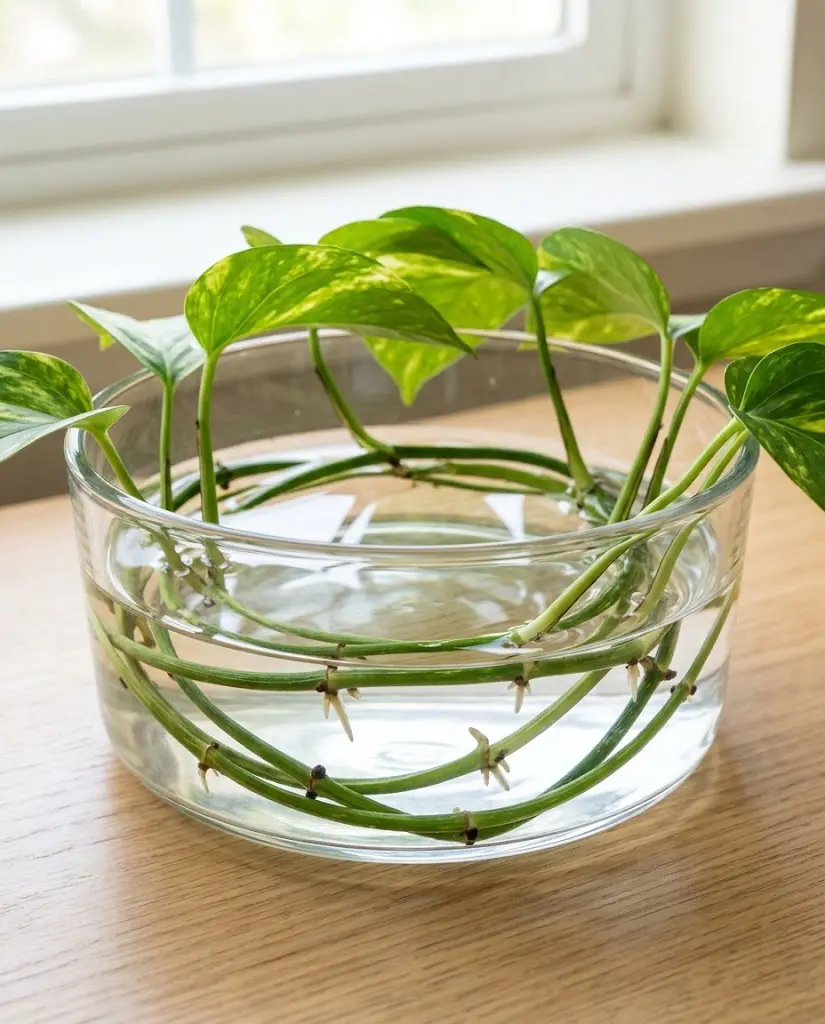
Coiled Vine vs. Short Pothos Cuttings
Both approaches use the same important part of the plant: a healthy stem node.
| Method | Useful when | Main tradeoff |
|---|---|---|
| Long coiled vine | You want to keep more of the vine together | Several nodes can be harder to position and monitor |
| Short node cuttings | You want several separate plants | The original vine must be divided into smaller pieces |
If your goal is to create a fuller pot, rooting several separate cuttings can be useful because the established cuttings can later be planted together.
How to Make Standard Pothos Cuttings
If the long-vine method feels awkward, divide the stem into smaller sections instead.
- Find a healthy node on the main vine.
- Use clean scissors or pruning snips.
- Cut the stem so the section keeps at least one useful node.
- Remove a lower leaf if it would remain underwater.
- Place the node in water while keeping the remaining foliage above the surface.
- Keep the cutting in bright, indirect light while roots develop.
When Should You Move Pothos From Water to Soil?
You do not need to wait until the container is filled with a huge mass of roots.
Once a cutting has developed a useful young root system, prepare a small pot with drainage holes and an airy, well-draining potting mix.
Handle young roots gently. During the first part of the transition, avoid allowing the potting mix to become extremely dry.
Once the cutting is established, return to normal pothos watering based on the condition of the potting mix.
How to Make a Pothos Look Fuller
Propagation can be useful when an older pothos has one or two very long vines but looks sparse close to the pot.
Instead of planting one rooted cutting alone, you can root several pieces and later arrange them around the original plant.
This creates more growing points in the container and can make the plant look fuller over time.
Do not overcrowd the container just to create an instant result. Roots still need suitable potting mix, drainage, and space.
If the parent plant already has yellow, brown, or damaged leaves, check the underlying problem before taking a large number of cuttings. FarmSolo’s plant leaf problem guide can help you inspect the plant first.
Common Pothos Propagation Mistakes
- Using a leaf without a useful stem node. The node is the important propagation point.
- Submerging too many leaves. Keep foliage above the water whenever possible.
- Forcing a stiff vine into a small bowl. Use a wider container or make shorter cuttings.
- Ignoring dirty water. Replace it if it becomes cloudy, smelly, or filled with decaying material.
- Starting with damaged stem tissue. Healthy, firm vine sections are easier to work with.
- Putting the bowl in harsh direct sun. Bright indirect light is a better starting point.
- Waiting for an enormous root mass. A cutting does not need to fill the container with roots before moving to potting mix.
What If the Pothos Stem Starts Rotting?
A healthy pothos stem should remain reasonably firm while it roots.
If part of the stem becomes black, mushy, or foul-smelling, remove the damaged section with clean scissors instead of leaving it in the propagation container.
Clean the container and restart with healthy stem tissue that still contains a viable node.
Also remove decaying leaves or other plant material from the water.
A Small Safety Note About Pothos
Pothos should not be treated as an edible plant.
The plant contains calcium oxalate crystals, and chewing it can irritate the mouth. The sap may also irritate sensitive skin.
Practical safety: Wash your hands after handling fresh cut stems if the sap bothers your skin, and keep pothos where children or pets cannot chew it.
Pothos Propagation FAQ
Can you propagate pothos without cutting the vine into many pieces?
A longer section can develop roots from healthy nodes kept in suitable rooting conditions. However, shorter node-containing cuttings are the more commonly documented and easier-to-manage method.
Does every pothos cutting need a node?
Yes. A useful pothos stem cutting should contain at least one node because that is where new roots and growth can develop.
Can several pothos nodes be underwater at once?
A longer stem can have several nodes positioned in water at the same time. Keep the foliage above the water when possible and inspect the vine for deterioration.
How long does pothos take to root in water?
University horticulture references commonly describe pothos rooting in roughly three to four weeks under suitable conditions, although conditions in a home can make the process faster or slower.
Should you change pothos propagation water?
Replace the water when it becomes cloudy, smells unpleasant, or contains decaying material. Also top it up as needed so the rooting nodes remain in contact with water.
Is water or soil better for pothos propagation?
Pothos can root in either water or an appropriate rooting medium. Water makes root development easy to see, while rooting directly in a suitable medium avoids the later transition from water to potting mix.
Does the Bowl Method Make Sense?
The bowl idea can be useful when you have a long, flexible pothos vine and want several nodes in contact with water without filling a windowsill with separate jars.
But the circular shape itself is not the propagation trick. The important part is keeping healthy nodes in suitable rooting conditions.
If the vine bends comfortably, a shallow bowl can be a practical option. If the vine is stiff, damaged, or difficult to position, shorter node cuttings are usually simpler.
That distinction lets you use the Pinterest idea as inspiration without treating it as a guaranteed method that every pothos needs.