The first time I tried growing vegetables from kitchen scraps, I honestly thought I had discovered some kind of homesteading cheat code.
I had a bunch of green onions sitting in the fridge. The roots were still attached, so I stuck the bottoms in a little glass of water and put it on the kitchen windowsill. A few days later, green shoots were popping back up.
I was hooked.
Since then, I’ve tried all kinds of vegetables you can regrow in water. Some worked surprisingly well. Some grew for a while and then turned into a slimy mess. And a few were basically a waste of time.
That’s the part I want to talk about.
You’ll see plenty of videos online where people stick a vegetable in water and suddenly have a giant harvest. Real life isn’t always like that. But regrowing scraps can still be a great little project, especially if you’re doing urban homesteading, growing food in a small backyard, or just trying to waste less food.
So grab a few scraps from your kitchen, find a sunny window, and lemme show you what I’ve learned.
Can You Really Regrow Vegetables in Water?
Yep, but there’s a little catch.
When you regrow vegetables in water, you’re usually encouraging the plant to produce new leaves, stems, or roots. You’re not always going to get another full-size vegetable.
That distinction took me a while to figure out.
Green onions can keep producing fresh green tops. Lettuce can give you another round of tender leaves. Celery can grow new leaves from the base.
But sticking a carrot top in water isn’t going to give you another giant carrot underneath it.
I learned that one after staring at a carrot top for weeks like something magical was supposed to happen.
The good news is that you can still get useful food from a lot of scraps.
And if you’re teaching kids about gardening, this is one of the easiest ways to show them how plants grow.
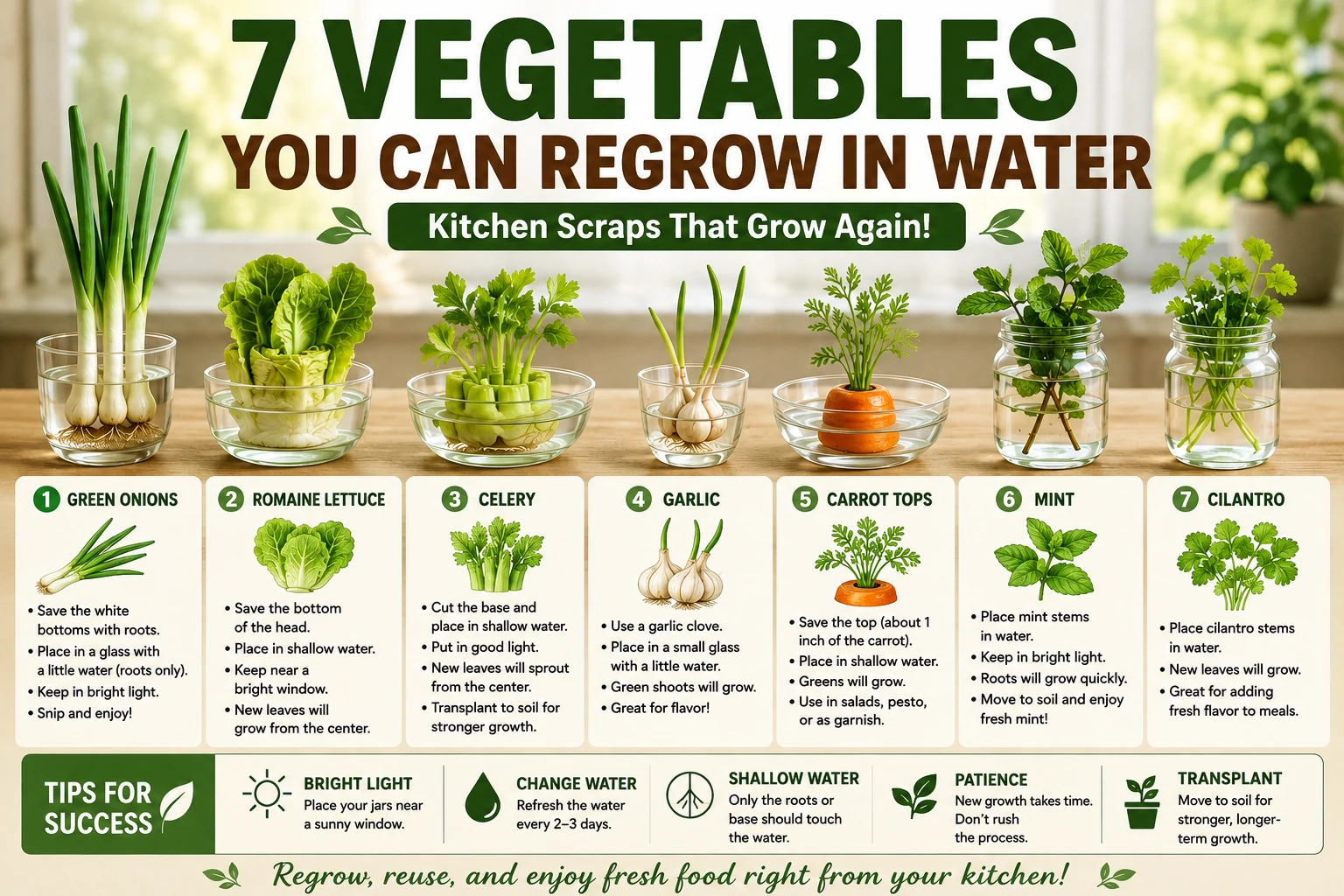
1. Green Onions Are Probably the Easiest
If you only try one of these vegetables you can regrow in water, start with green onions.
I’ve had the best luck with these because they’re ridiculously simple.
Save the white bottom section with the roots attached. Put it in a small glass or jar with just enough water to cover the roots.
Then put it somewhere bright.
Within several days, you should start seeing new green growth.
Here’s the mistake I used to make: I’d completely submerge the onion.
Don’t do that.
You only need the roots and lower portion touching the water. If the entire thing sits underwater, it can start getting soft and rotten.
I change the water every couple of days and rinse the container if it starts looking cloudy.
Once the green tops grow tall enough, I snip what I need with kitchen scissors.
Leave the bottom in place and it can keep producing new growth for a while.
It won’t replace an entire onion harvest, but for cooking, soups, eggs, and stir-fries, it’s pretty darn handy.
2. Romaine Lettuce Is Another Easy One
Romaine lettuce was another surprise for me.
After using the leaves, save the bottom part of the head. Put it in a shallow dish with a little water.
You don’t need to drown it.
Just enough water to keep the bottom moist.
Place it near a bright window and watch the center.
New leaves should start appearing from the middle.
The first time I did this, I kept waiting for another full head of lettuce.
That didn’t happen.
What I got was a handful of fresh young leaves, which was still worth it because I had already eaten the original lettuce.
That’s how I look at kitchen-scrap gardening now.
If I get free fresh greens from something I was going to throw away anyway, that’s a win.
3. Celery Can Grow Again From the Base
Celery is another good experiment.
Save the bottom section after cutting off the stalks. Place it in a shallow bowl with water.
Put it somewhere that gets good light.
After a few days, you may notice little green leaves forming in the center.
This is where patience helps.
Don’t expect a whole bunch of celery stalks overnight. The new growth starts small.
I like using the young leaves in soups and stews.
Once you see roots developing, you can also move the plant into soil if you want to keep growing it.
That’s actually the part I prefer.
Water is great for getting the plant started, but soil gives it a much better chance of producing stronger long-term growth.
4. Bok Choy Is Surprisingly Good
If you eat bok choy, save the bottom.
This one can look almost dead when you first put it in water. Then suddenly you see new leaves coming out of the center.
It’s pretty cool.
Use a shallow container and add enough water to keep the base from drying out.
Change the water regularly.
Once new roots and leaves develop, you can transplant it into a container or garden bed.
This works especially well if you’re doing backyard gardening but don’t have much room.
A sunny patio, balcony, or small raised bed can give you plenty of space for experiments like this.
5. Cabbage Can Regrow From the Core
Cabbage works in a similar way.
Save the bottom portion after you’ve used the cabbage.
Put the core in a shallow dish with water and place it near a bright window.
New leaves may start growing from the center.
Now, here’s where I don’t want to oversell it.
You probably aren’t going to get a massive replacement cabbage sitting on your kitchen counter.
What you can get is new leafy growth that can be harvested or transplanted.
If you’re interested in self-sufficient gardening, this is still worth trying because it teaches you how to get more use out of food scraps.
And honestly, watching the little leaves come back is half the fun.
6. Leeks Are Worth Trying
Leeks behave a lot like green onions.
Save the root end with a little bit of the white stem attached.
Stand it upright in a shallow glass of water.
Keep the roots wet and give it plenty of light.
New green growth should appear from the middle.
Leeks can eventually be moved into soil if you want to continue growing them.
This is one of those projects where I like to keep several scraps going at once.
One jar doesn’t take much room.
Five jars still don’t take much room.
Before you know it, your kitchen windowsill looks like a tiny little farm.
My wife wasn’t exactly thrilled about that part.
7. Fennel Can Come Back From the Base
Fennel isn’t the first vegetable most people think about when they hear about regrowing scraps, but the base can produce new green growth.
Save the bottom portion and place it in shallow water.
Keep the water fresh and give it good light.
The new growth can be used for cooking.
Again, think of this as harvesting fresh greens rather than creating an entire new bulb every time.
That’s an important expectation to have with water regrowing.
8. Carrot Tops Are Fun, But Don’t Expect Another Carrot
This one causes a lot of confusion.
Yes, you can grow carrot greens from the top of a carrot.
No, you generally aren’t going to grow another big carrot from the top.
Save the top portion with a little carrot attached. Put it cut-side down in a shallow dish with water.
New green leaves can grow from the center.
I like using carrot greens in small amounts in cooking, or just keeping them around as a fun gardening experiment.
My first attempt ended with too much water and not enough light.
The top got soft.
That taught me something pretty important: water doesn’t replace sunlight.
What I Learned About Growing Vegetables in Water
After messing around with all these scraps, I noticed a few things that made a huge difference.
Light Matters More Than You Think
Put your scraps near a bright window.
Plants need light to make healthy new growth.
A dark corner of the kitchen isn’t going to magically turn into a vegetable garden.
I’ve had scraps grow pale and weak when they weren’t getting enough light.
Move them closer to a sunny window and you’ll usually notice a difference.
Don’t Drown the Plants
This is probably my biggest beginner mistake.
I used to think more water meant faster growth.
Nope.
Too much water can encourage rot.
The roots need moisture, but the whole vegetable doesn’t need to sit underwater.
Use shallow containers whenever possible.
Change the Water Regularly
If your water gets cloudy or starts smelling bad, that’s your warning.
Dump it.
Rinse the container and start with fresh water.
I usually change the water every couple of days, especially when the container is warm.
Clean containers are simple insurance against a nasty little kitchen experiment.
Move Them Into Soil When They’re Ready
Water is excellent for getting some plants started.
But if you want long-term growth, soil is usually the better place.
Once you see healthy roots developing, transplant the scrap into a pot filled with good-quality potting mix.
Keep it watered, but don’t turn the pot into a swamp.
I’ve had much better results this way than trying to keep everything growing in water forever.
My Favorite Vegetables to Regrow in Water
If you don’t want to experiment with ten different scraps, start with these:
Easiest:
Green onions
Romaine lettuce
Celery
Bok choy
Leeks
Fun experiments:
Cabbage
Fennel
Carrot tops
Green onions are still my number one.
They’re fast, useful, and forgiving when you forget about them for a day or two.
Can You Grow Vegetables in Water Without Soil?
For short-term regrowing, yes.
You can produce new leafy growth from several vegetable scraps using nothing more than water and sunlight.
But there’s a difference between regrowing and fully growing a vegetable.
A plant needs nutrients to keep producing healthy growth. Water alone doesn’t contain everything a plant needs.
That’s why I recommend treating kitchen-scrap regrowing as a starting point.
Get the roots growing in water, then move the plant into soil when appropriate.
If you want to go further, you can also learn about hydroponic gardening, where plants are grown without traditional soil but receive nutrients through water.
That’s a whole different ball game.
My Biggest Mistakes With Kitchen Scrap Gardening
I’ve made plenty.
I left water sitting too long.
I put plants in containers that were too deep.
I didn’t give them enough light.
I tried growing things that simply weren’t worth the effort.
And yes, I forgot about a jar of green onions on the windowsill until it smelled like something had crawled in there and died.
Don’t ask.
The biggest lesson was to keep it simple.
You don’t need special equipment.
You don’t need expensive grow lights for every little experiment.
You don’t need a fancy indoor garden system.
Start with a glass, some water, a sunny window, and a vegetable scrap that still has healthy roots or a growing center.
That’s it.
A Simple Kitchen Regrowing Routine
Here’s what I do when I have vegetable scraps worth saving.
I cut off the useful bottom section.
I rinse it.
I put it in a small container with fresh water.
I place it near a bright window.
Every couple days, I check the water.
If it looks dirty, I change it.
If new growth appears, I let it keep going.
Once the plant has decent roots, I decide whether to harvest the greens or move it into soil.
Nothing fancy.
That’s one of the things I like most about homesteading. Sometimes the best projects are the ones that cost almost nothing.
FAQ About Vegetables You Can Regrow in Water
What vegetables can I regrow in water?
Some good choices include green onions, romaine lettuce, celery, bok choy, cabbage, leeks, fennel, and carrot tops. Results vary, and many will produce new greens rather than a completely new vegetable.
How long does it take to regrow vegetables in water?
It depends on the vegetable, light, temperature, and condition of the scrap. Green onions can show new growth within several days, while other vegetables may take longer.
Do I need sunlight?
Yes. Bright natural light is important for healthy new growth. A sunny windowsill is a great place to start.
Can I keep vegetables growing in water forever?
Usually not if you’re expecting strong, productive plants. Water can work for starting new growth, but many plants will do better when moved into nutrient-rich soil.
Final Thoughts
The first time I stuck a green onion in water, I wasn’t trying to become more self-sufficient.
I was just curious.
But little experiments like that changed how I look at food.
A vegetable doesn’t always have to go straight from the grocery bag to the trash when we’re finished eating it. Sometimes there’s still a little life left in that scrap.
And that’s really what I love about growing vegetables you can regrow in water.
It’s cheap. It’s simple. It works in a tiny apartment, an urban kitchen, a backyard homestead, or a big country garden.
Will you grow a whole year’s worth of food from scraps?
Nope.
But you’ll get fresh greens, reduce some waste, learn how plants behave, and maybe get hooked on gardening like I did.
Start with green onions. They’re almost impossible to mess up.
And if you get a weird little jar of roots growing on your windowsill, don’t worry. You’re officially homesteading now.
Got a vegetable scrap that’s giving you trouble? Ask me about it. I’ve probably already killed one.