
Whole-kernel sweet corn can be safely preserved at home, but it must be processed in a pressure canner. Corn is a low-acid vegetable, so a boiling-water bath cannot reach the temperatures needed for safe processing.
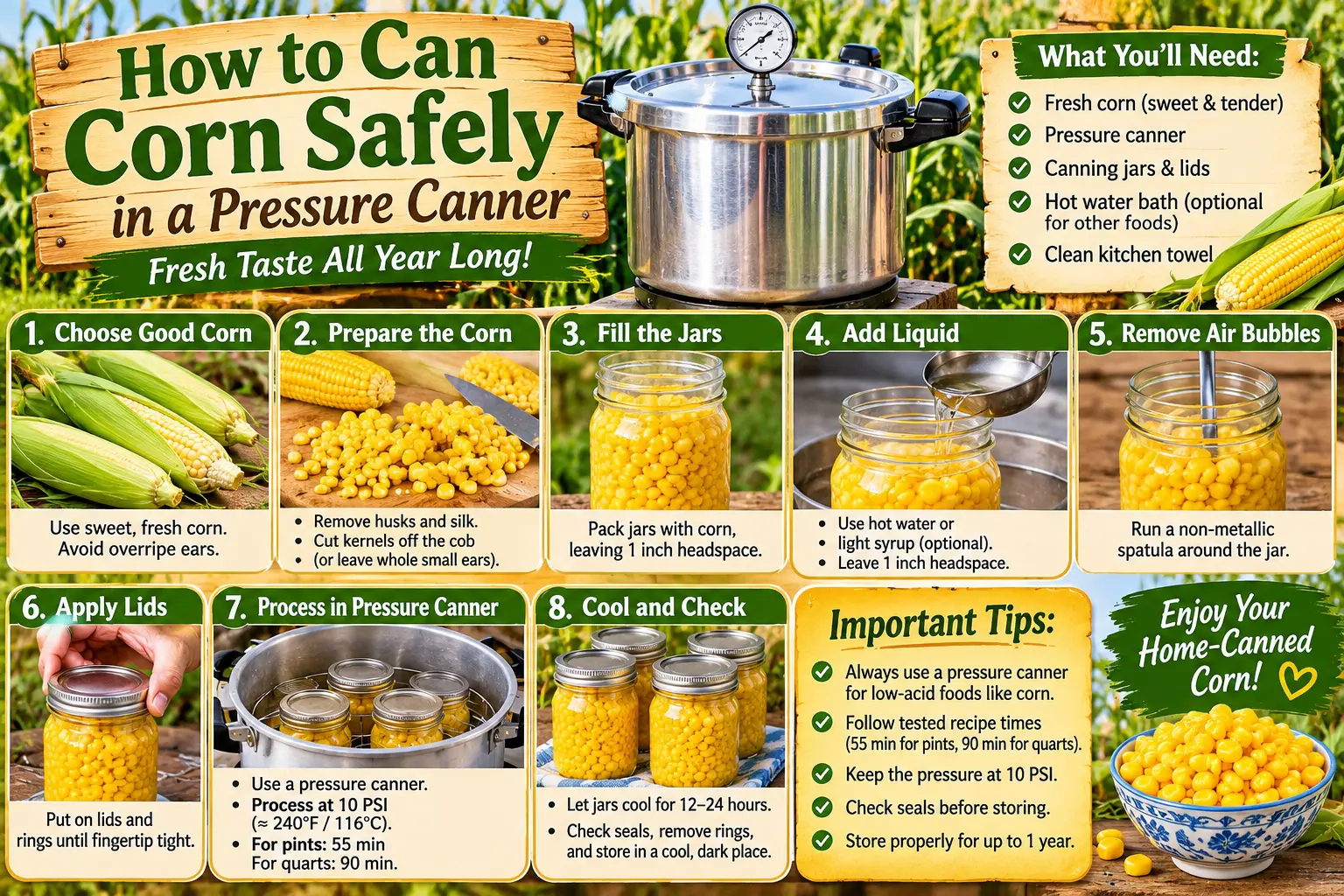
The Pinterest graphic gets the basic processing times right for whole-kernel corn—55 minutes for pints and 85 minutes for quarts—but it leaves out one of the most important parts of the process: the required pressure must be adjusted for your canner type and altitude.
Safety first: use a true pressure canner, not a boiling-water canner and not a small pressure saucepan. Follow a tested USDA/NCHFP process and adjust pressure for your altitude.
Why Corn Must Be Pressure Canned
Corn is a low-acid food. Low-acid vegetables require temperatures higher than boiling water can provide in order to control the risk of botulism during shelf-stable canning.
That is why the National Center for Home Food Preservation specifies pressure canning for whole-kernel corn.
Use Good-Quality Sweet Corn
Choose fresh ears with kernels that are slightly immature or at ideal eating quality.
Penn State recommends canning or freezing sweet corn as soon as practical after harvest because quality declines quickly.
Husk the ears, remove the silk, and wash thoroughly.
Ingredients and Equipment
- Fresh sweet corn
- Fresh boiling water
- Canning or pickling salt, optional
- Pressure canner
- Pint or quart canning jars
- New lids prepared according to the manufacturer’s directions
- Jar lifter
- Bubble-removal tool or suitable nonmetallic utensil
- Clean damp cloth or paper towel for jar rims
Step 1: Blanch the Corn
For tested whole-kernel corn preparation, blanch the ears in boiling water for 3 minutes.
After blanching, cut the kernels from the cob at about three-fourths of the kernel depth.
Do not scrape the cob when preparing whole-kernel corn. Scraped corn becomes denser and needs a different tested process.
Choose Hot Pack or Raw Pack
NCHFP provides tested instructions for both hot-pack and raw-pack whole-kernel corn.
Hot Pack
For every quart of corn kernels, add 1 cup of hot water in a saucepan.
Bring to a boil and simmer for 5 minutes.
Pack the hot corn and cooking liquid into jars, leaving 1 inch of headspace.
Raw Pack
Loosely fill jars with prepared raw corn kernels, leaving 1 inch of headspace.
Do not shake or press the kernels down. Corn expands during processing.
Add fresh boiling water, maintaining the 1-inch headspace.
How Much Salt Should You Add?
Salt is optional in pressure-canned corn. It is added for flavor, not safety.
| Jar Size | Optional Salt |
|---|---|
| Pint | ½ teaspoon |
| Quart | 1 teaspoon |
You can also leave the salt out entirely.
Remove Air Bubbles and Check Headspace
Run a suitable utensil around the inside of the jar to release trapped air bubbles.
Recheck the liquid level and maintain 1 inch of headspace.
Wipe the jar rim clean, apply the lid, and tighten the band according to the lid manufacturer’s directions.
Whole-Kernel Corn Processing Times
Pints: 55 minutes
Quarts: 85 minutes
These times apply to both hot-pack and raw-pack whole-kernel corn, but the correct pressure depends on altitude and whether you are using a dial-gauge or weighted-gauge canner.
Dial-Gauge Pressure Canner
| Elevation | Pressure |
|---|---|
| 0–2,000 ft | 11 PSI |
| 2,001–4,000 ft | 12 PSI |
| 4,001–6,000 ft | 13 PSI |
| 6,001–8,000 ft | 14 PSI |
Weighted-Gauge Pressure Canner
| Elevation | Pressure |
|---|---|
| 0–1,000 ft | 10 PSI |
| Above 1,000 ft | 15 PSI |
Do not use only the Pinterest processing time and ignore pressure. Safe pressure canning requires both the full processing time and the correct pressure for your altitude.
Vent the Pressure Canner First
Before pressurizing the canner, allow a strong continuous stream of steam to escape through the open vent for the time specified by your canner instructions and tested canning guidance—commonly about 10 minutes.
Then close the vent or apply the weight and bring the canner to the required pressure.
Start Timing Only After Correct Pressure Is Reached
Do not start the 55- or 85-minute clock while the canner is still heating.
The processing time begins only when the canner has reached the required pressure.
What if the Pressure Drops?
If pressure falls below the required level at any point during processing, bring the canner back to the correct pressure and restart the full processing time from the beginning.
Do not simply add a few minutes to compensate.
Let the Canner Cool Naturally
At the end of processing, remove the canner from the heat and allow it to depressurize naturally.
Do not cool the canner with cold water, lift the weight early, or force the lid open.
Forced cooling can cause liquid loss, seal failures, and food spoilage.
Remove Jars Carefully
Once the canner is fully depressurized according to the manufacturer’s instructions, open the lid away from your face so steam escapes in the opposite direction.
Lift the jars straight up and place them on a towel or rack where air can circulate.
Do not tighten the bands or press down on the lids while the jars are cooling.
Check the Seals
After the jars have cooled completely, check every seal.
If a jar did not seal, refrigerate it and use it promptly or follow current tested guidance for safe reprocessing within the permitted time.
Store Without the Screw Bands
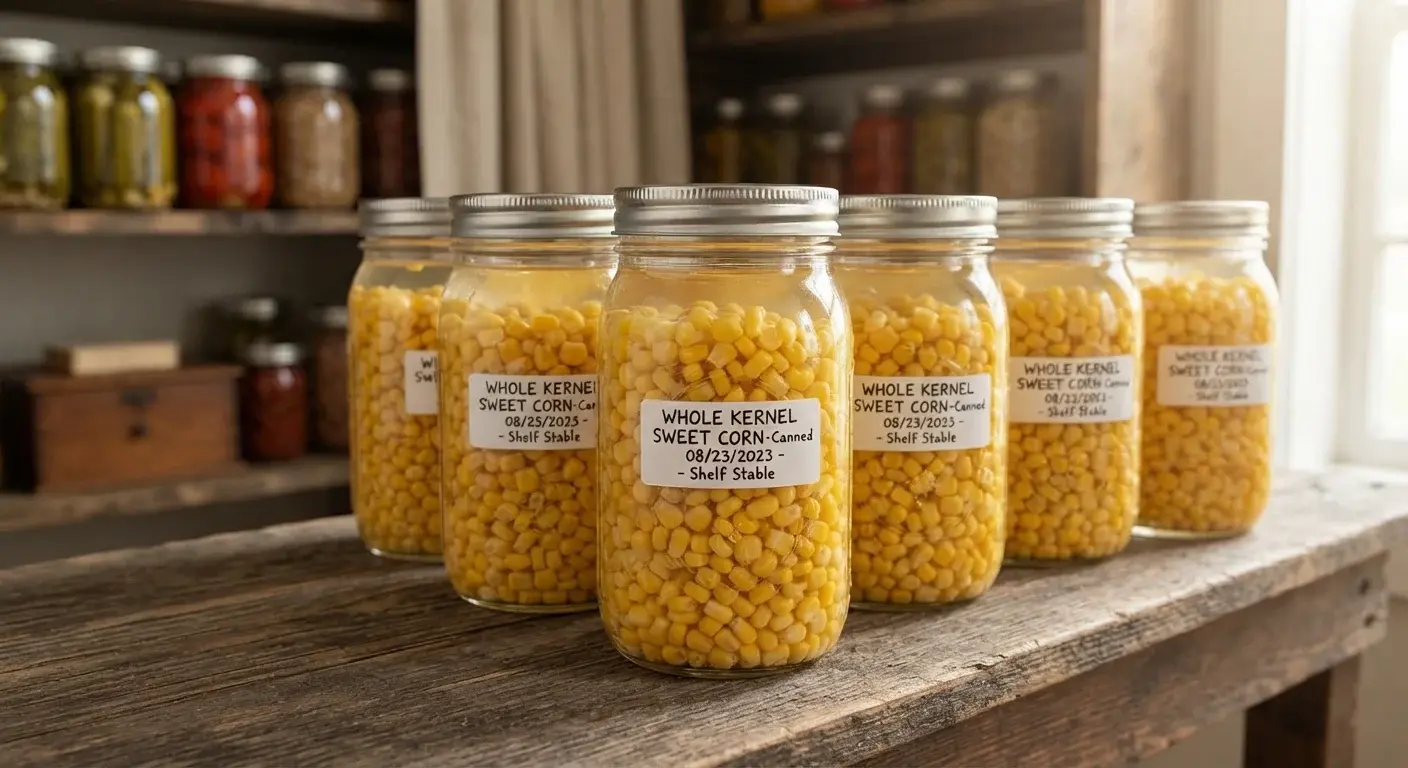
Once seals are confirmed, remove the screw bands, wash any residue from the jars, label them, and store them in a cool, dark, dry location.
Leaving bands off also makes it easier to notice a seal failure during storage.
Why Corn Needs Extra Headspace
Corn contains a lot of starch and expands during processing.
Penn State emphasizes packing whole-kernel corn loosely and maintaining a full 1 inch of headspace.
Do not pack the jar tightly to squeeze in extra kernels.
Can You Add Sugar?
The Pinterest image suggests adding sugar if desired.
The tested NCHFP whole-kernel corn process does not call for sugar.
For FarmSolo, I would leave sugar out and follow the tested formula exactly. Sweet corn already contains natural sugars, and there is no preservation reason to add more.
Can You Add Butter or Milk?
No. Do not add butter, cream, milk, cheese, flour, or other untested ingredients to jars of pressure-canned corn.
Add butter or dairy only after opening the jar when preparing the corn for serving.
Whole-Kernel Corn vs. Cream-Style Corn
These are not interchangeable canning methods.
| Type | Jar Size | Processing |
|---|---|---|
| Whole kernel | Pints or quarts | 55 min pints / 85 min quarts |
| Cream style | Pints only | 85 minutes |
NCHFP specifically says quart jars are not recommended for cream-style corn because the dense product heats too slowly.
Common Corn-Canning Mistakes
Using a Water-Bath Canner
Corn is low-acid and requires pressure canning.
Forgetting Altitude Adjustment
Higher elevations require higher pressure. Processing for the correct number of minutes at insufficient pressure is not equivalent.
Packing the Corn Too Tightly
Corn expands during processing. Pack it loosely and keep 1 inch of headspace.
Scraping the Cob for Whole-Kernel Corn
Scraping adds starch and pulp and changes the density of the product. Follow the separate cream-style process if that is the product you want.
Adding Dairy or Thickening Ingredients
Do not add butter, milk, cream, flour, or other thickeners before canning.
Force-Cooling the Canner
Let the pressure canner cool naturally. Opening or cooling it prematurely can cause siphoning and seal problems.
Pressure-Canned Corn FAQ
How long do you pressure-can corn?
For tested whole-kernel corn, process pints for 55 minutes and quarts for 85 minutes at the correct pressure for your altitude.
Can I water-bath canned corn?
No. Plain corn is a low-acid vegetable and requires a pressure canner for shelf-stable home canning.
Do I have to add salt?
No. Salt is optional for flavor and does not make plain canned corn safe.
How much salt goes in canned corn?
If desired, use ½ teaspoon per pint or 1 teaspoon per quart.
How much headspace does corn need?
Leave 1 inch of headspace for tested whole-kernel corn recipes.
Can I can cream-style corn in quart jars?
No. NCHFP recommends pint jars only because cream-style corn is too dense for the tested quart process.
Why did my canned corn turn darker?
Some very sweet varieties or very immature corn can darken during canning. NCHFP recommends trying a small batch when you are unsure how a variety will respond.
The Bottom Line
Pressure-canned sweet corn is a useful way to preserve a productive summer harvest for soups, casseroles, side dishes, and winter meals.
The critical details are simple but non-negotiable: use a pressure canner, blanch and cut the corn according to the tested method, leave 1 inch of headspace, process pints for 55 minutes or quarts for 85 minutes, and use the correct pressure for your altitude.
Sources
- National Center for Home Food Preservation — Corn, Whole Kernel
- National Center for Home Food Preservation — Using Pressure Canners
- Penn State Extension — Let’s Preserve: Sweet Corn
- Penn State Extension — Preserving Sweet Corn Successfully