FARMSOLO • OFF-GRID LIVING
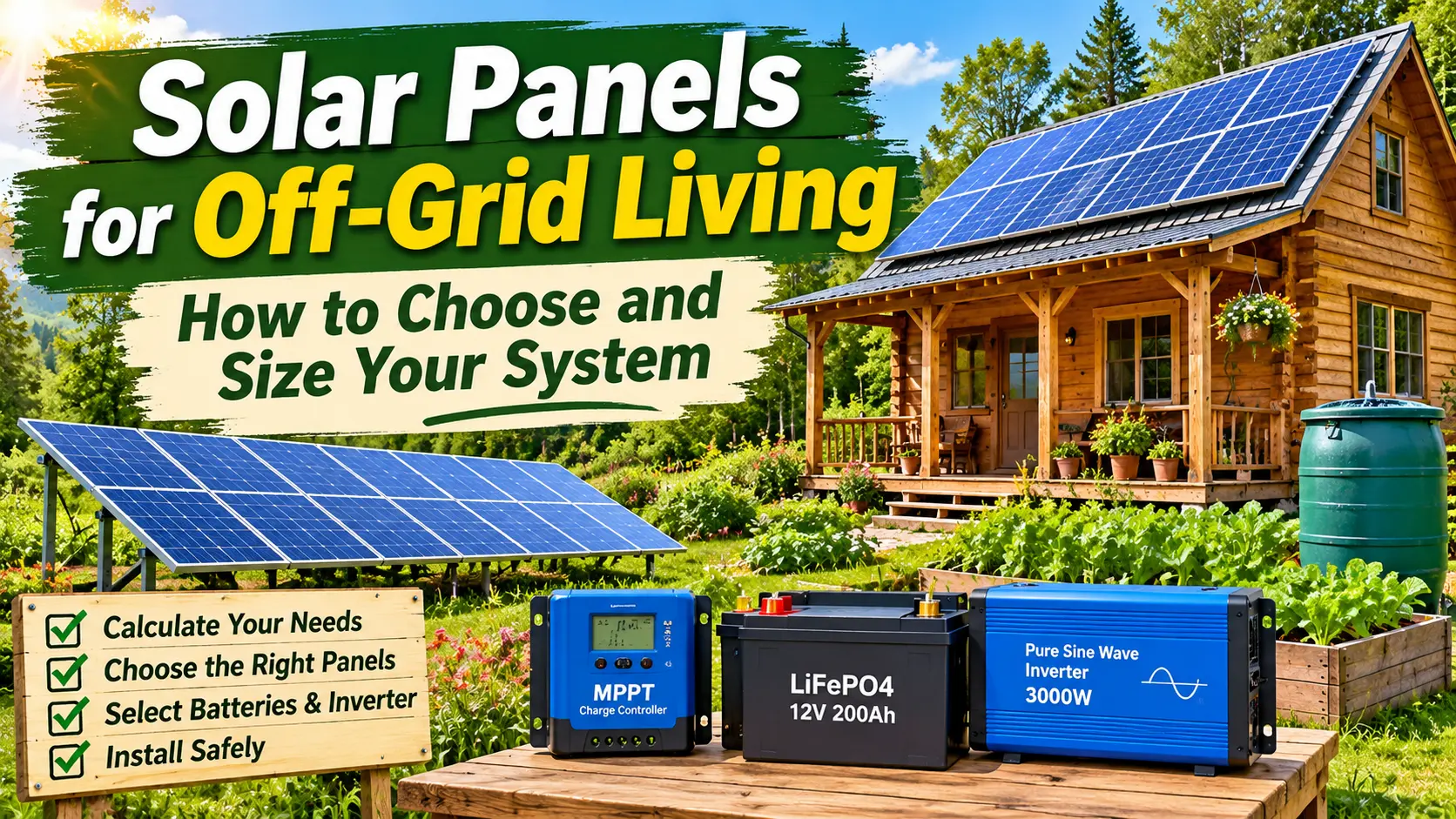
Solar Panels for Off-Grid Living: How to Choose and Size Your System
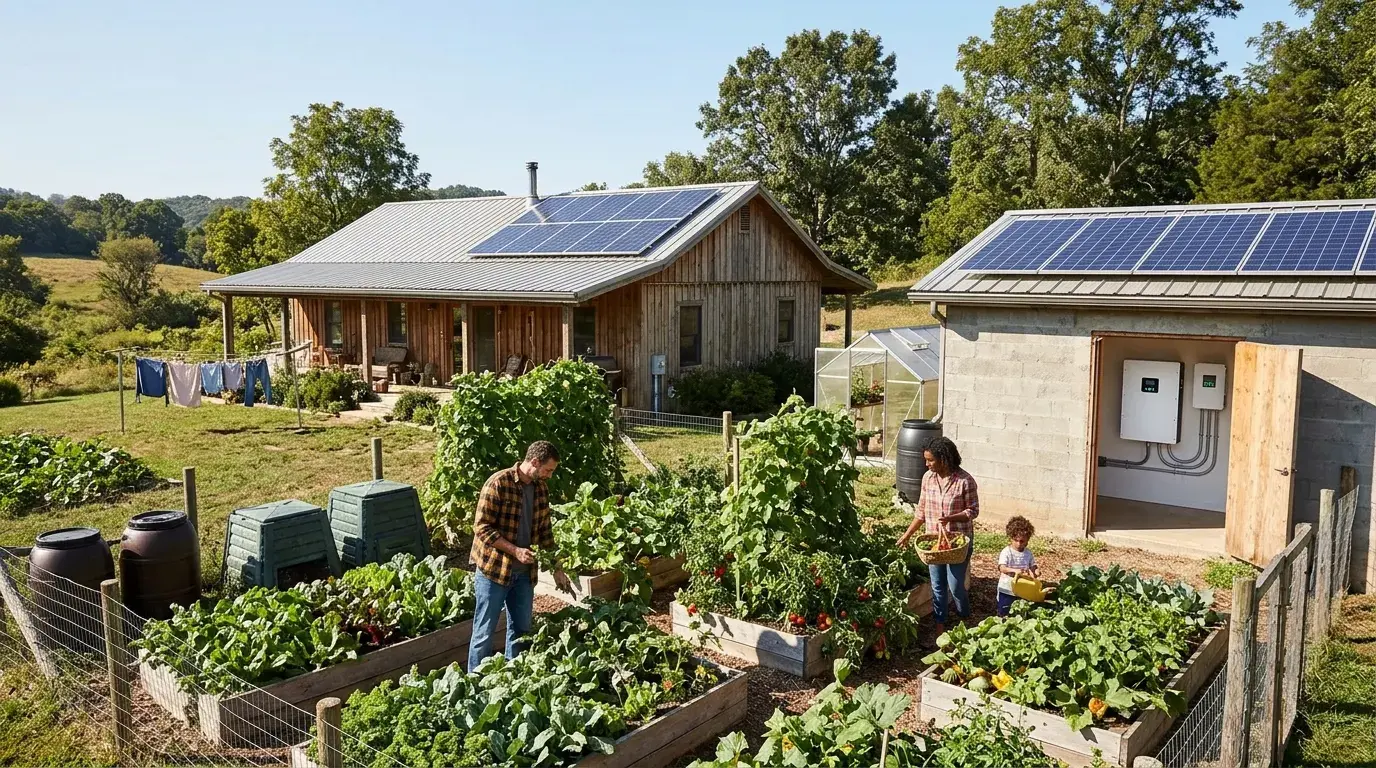
Solar Panels for Off-Grid Living . Living off the grid sounds pretty appealing until you start thinking about the electricity. Your refrigerator needs power. Your water pump needs power. You want lights at night, a way to charge your phone, and maybe even a washing machine.
That’s where solar panels for off-grid living can make a real difference. A properly designed solar power system can provide electricity without depending on a utility connection. But here’s something worth understanding before spending your money: buying a few solar panels doesn’t automatically give you a reliable off-grid power system.
You also need battery storage, a suitable inverter, a charge controller, electrical protection, and enough solar production to cover your needs during less sunny periods.
In this guide, I’ll walk through the main components, explain how to estimate your electricity use, and show you how to approach system sizing without buying equipment you don’t actually need.
The best solar panels for off-grid living are part of a complete system designed around your daily electricity use, local sunlight, battery capacity, and backup needs. Start by calculating your energy consumption, then size the solar array, batteries, inverter, and charge controller to work together.
1. How Does an Off-Grid Solar Power System Work?
An off-grid solar system produces and stores electricity for a property that is not connected to the utility grid. Solar panels collect sunlight and convert it into direct-current electricity (DC). A charge controller manages the electricity going into the battery bank, while an inverter converts battery power into alternating current (AC) for household appliances.
A typical system includes these main components:
- Solar panels: Generate electricity from sunlight.
- Charge controller: Regulates charging and helps protect the battery bank.
- Battery bank: Stores electricity for nighttime and periods of low solar production.
- Inverter: Converts DC electricity into AC electricity for compatible household appliances.
- Wiring and protection: Includes correctly rated cables, fuses, breakers, disconnects, and grounding equipment.
Some systems use an all-in-one inverter with a built-in solar charge controller. Others use separate components. Either approach can work when the equipment is correctly matched.
2. How Many Solar Panels Do You Need for Off-Grid Living?
This is usually the first question people ask. Unfortunately, there isn’t one panel count that works for every home.
Solar Panels for Off-Grid Living A small cabin that uses a few lights, a refrigerator, and phone chargers has very different electricity needs from a full-time homestead with a well pump, freezer, washing machine, workshop, and other appliances.
The right starting point is your daily energy consumption, measured in watt-hours (Wh) or kilowatt-hours (kWh).
Step 1: Make a List of Your Appliances
Write down the appliances you plan to use, their power ratings, and how long you expect to operate them each day.
| Appliance | Example Power | Daily Use | Energy |
|---|---|---|---|
| LED lights | 40 W | 5 hours | 200 Wh |
| Refrigerator | 100 W average while running | 8 equivalent hours | 800 Wh |
| Laptop | 60 W | 4 hours | 240 Wh |
| Water pump | 500 W | 1 hour | 500 Wh |
| TV | 80 W | 3 hours | 240 Wh |
| Phone charging | 20 W | 2 hours | 40 Wh |
| Example Daily Total | 2,020 Wh | ||
Important: These are illustrative numbers, not measured consumption figures. A refrigerator cycles on and off, and its real daily energy use depends on its model, temperature, location, and usage. Check the manufacturer’s energy label or measure the appliance with a suitable energy meter. Also account for inverter standby consumption and other loads you may have missed.
Step 2: Estimate Your Solar Panel Capacity
Once you know your daily energy requirement, you can estimate the solar array size.
A simplified planning formula is:
Daily Energy (Wh) ÷ [Peak Sun Hours × System Efficiency]
Let’s use the example above:
- Daily energy use: 2,020 Wh
- Assumed peak sun hours: 4 hours
- Illustrative overall system efficiency: 75%
Calculation:
2,020 ÷ (4 × 0.75) = approximately 673 watts.
This is a simplified starting estimate. A real system may need a larger array to account for seasonal sunlight, cloudy weather, temperature, shading, panel orientation, battery charging losses, and future energy needs.
Do not use four peak sun hours as a universal value. Your location and the time of year matter. Check the solar resource for your actual installation site, especially during the least sunny part of the year.
3. Choose the Right Type of Solar Panels
Not all solar panels are identical. Different technologies have different characteristics, costs, and space requirements.
Monocrystalline Solar Panels
Monocrystalline panels are made from single-crystal silicon cells. They are widely used in residential solar systems and are known for their relatively high efficiency and compact space requirements.
They can be a good option when roof space or available ground area is limited.
Polycrystalline Solar Panels
Polycrystalline panels are made from multiple silicon crystals. They have traditionally offered a lower-cost alternative, although product availability and pricing vary by market.
Compare the actual rated output, efficiency, warranty, dimensions, and total installed cost rather than choosing only by the panel technology.
Bifacial Solar Panels
Bifacial panels can collect sunlight from both their front and rear surfaces. Their additional energy production depends on the installation, rear-side exposure, mounting height, and how reflective the surface below the panels is.
They may be worth considering for suitable ground-mounted installations, but don’t assume they will automatically produce a fixed percentage more electricity.
For an off-grid home, compare panels using their rated wattage, efficiency, physical size, temperature characteristics, warranty, and compatibility with your charge controller. The best panel is the one that fits your complete system and site conditions.
4. Choose a Battery Bank That Can Handle Your Needs
Solar panels produce electricity when sunlight is available. But your home still needs power after sunset and during periods when the panels cannot produce enough.
That’s why battery storage is such an important part of off-grid living.
Lithium Iron Phosphate (LiFePO4) Batteries
LiFePO4 batteries are popular in many modern off-grid systems because they offer useful energy density, long cycle life, and a relatively high usable capacity when operated within the manufacturer’s limits.
They usually cost more upfront than basic lead-acid batteries. They also require a compatible battery management system (BMS) and proper temperature protection.
Lead-Acid Batteries
Lead-acid batteries, including AGM and flooded types, remain available for off-grid applications. They may have a lower initial purchase price, but usable capacity, maintenance requirements, ventilation, and expected cycle life need careful consideration.
Regularly discharging lead-acid batteries too deeply can shorten their service life.
How Much Battery Storage Do You Need?
Battery capacity depends on daily energy consumption, the number of days of backup you want, usable depth of discharge, and system efficiency.
For a simplified example, imagine you use 2,020 Wh per day and want two days of battery autonomy.
- Daily energy: 2,020 Wh
- Autonomy: 2 days
- Assumed usable depth of discharge: 80%
- Assumed battery-to-load efficiency: 90%
Estimated nominal battery capacity:
2,020 × 2 ÷ (0.80 × 0.90) = approximately 5,611 Wh.
That means you would start planning around a 5.6 kWh nominal battery bank under these assumptions. The final capacity must follow the battery manufacturer’s specifications and account for temperature, ageing, discharge limits, and actual load patterns.
More battery storage is not automatically better. A large battery bank also needs enough solar production to recharge it properly.
5. Select the Correct Off-Grid Inverter
The inverter converts DC electricity from the battery into AC electricity for household appliances.
Choosing the right inverter is not simply about adding up the wattage of your solar panels. You need to consider which appliances may operate at the same time and whether any of them require extra starting power.
Pay attention to:
- Continuous power rating: The power the inverter can supply under its specified operating conditions.
- Surge rating: The temporary power available when certain motors or compressors start.
- Output voltage and frequency: Must match your appliances and local electrical system.
- Waveform: A pure sine wave inverter is generally the preferred choice for a household system.
- Battery compatibility: The inverter must match the battery bank’s voltage and operating requirements.
For example, a refrigerator or water pump may briefly require more power when its motor starts than it uses during normal operation. Check the appliance specifications and inverter surge rating before purchasing.
6. Don’t Overlook the Solar Charge Controller
The charge controller manages the electricity flowing from the solar panels to the battery bank.
Two common types are PWM and MPPT controllers.
- PWM: A simpler controller that can be suitable for some small systems when the panel voltage is appropriately matched to the battery bank.
- MPPT: Tracks the solar array’s maximum power point and can make better use of the panel output when array and battery voltages differ.
For many modern off-grid systems, MPPT is a practical choice. However, the controller must be selected according to the solar array’s maximum voltage and current, battery voltage, charging requirements, and manufacturer limits.
Never connect panels simply because their total wattage appears compatible. Check the electrical specifications of every panel string and the controller before installation.
7. Where Should You Install Your Solar Panels?
Panel placement can make a major difference in how much electricity your system produces.
Before installing anything, look at the property throughout the day and identify possible shading from trees, buildings, chimneys, and other obstacles.
Consider these factors:
- Sun exposure: Choose an area with strong sunlight during the important production hours.
- Shading: Even partial shading can reduce output, depending on the panel and string design.
- Orientation: Panel direction should be chosen for your location and energy goals.
- Tilt angle: The best angle depends on latitude, roof design, seasonal needs, and mounting constraints.
- Ventilation: Allow appropriate airflow around panels and follow the manufacturer’s installation instructions.
- Maintenance access: Make sure the array can be inspected and cleaned safely.
For a ground-mounted array, consider fencing, drainage, wind exposure, and protection from animals or accidental damage. For rooftop installations, check roof condition and structural suitability before adding equipment.
8. What Happens During Cloudy Days and Winter?
This is one of the biggest differences between grid-connected solar and a fully off-grid system.
A grid-connected household may still receive electricity from the utility when solar production falls. A fully off-grid home does not have that automatic backup.
During cloudy weather or shorter winter days, solar production can fall while your household still needs electricity.
Plan for those conditions by:
- Using solar production data for the least sunny months, not just summer.
- Reducing unnecessary electricity use during extended cloudy periods.
- Keeping enough battery storage for your planned autonomy.
- Considering a properly sized backup generator or another suitable energy source.
- Prioritizing essential loads if available energy becomes limited.
A backup generator can be useful, but it must be installed and operated safely outdoors, away from doors, windows, and ventilation openings. Never operate a generator inside a home, garage, shed, or enclosed space.
9. Example: A Small Off-Grid Cabin Solar Setup
Let’s put the ideas together with a simple planning example.
Imagine a small cabin with a refrigerator, lights, laptop, phone charging, television, and a water pump. The estimated daily energy use is around 2 kWh.
| System Part | Illustrative Planning Target |
|---|---|
| Daily energy use | About 2 kWh |
| Solar array | Around 700 W as a simplified starting estimate at 4 peak sun hours and 75% efficiency |
| Battery storage | Around 5.6 kWh nominal for the two-day example above |
| Inverter | Selected after checking simultaneous loads and motor starting surges |
| Charge controller | MPPT model matched to array voltage, current, and battery requirements |
This is an educational example, not a finished system design or a shopping list. The array estimate may be too small for a site with poor winter sunlight, shading, higher losses, or additional loads. A qualified designer should verify the final configuration using local solar data and the actual equipment specifications.
10. Common Mistakes When Building an Off-Grid Solar System
Buying solar equipment without planning the complete system can lead to expensive problems. Here are some mistakes worth avoiding.
- Buying panels before calculating energy use: Start with the appliances and daily consumption, not the advertised panel wattage.
- Ignoring winter production: A system that works well in summer may struggle during the least sunny season.
- Choosing batteries that are too small: Insufficient storage can leave you without power overnight or during cloudy weather.
- Choosing an inverter without checking surge loads: Pumps, refrigerators, and other motors can need extra starting power.
- Mixing incompatible equipment: Panel voltage, controller limits, battery charging settings, and inverter voltage must all match.
- Forgetting electrical protection: Correct fuses, breakers, disconnects, grounding, and cable sizing are essential.
- Ignoring maintenance: Connections, batteries, panels, mounting hardware, and ventilation need regular inspection.
11. How to Make Your Off-Grid Solar System More Efficient
Adding more panels is not always the first or cheapest solution. Reducing electricity demand can make an off-grid system easier and less expensive to operate.
Try these practical improvements:
- Replace older lights with efficient LED lighting.
- Choose appliances with lower energy consumption.
- Improve home insulation to reduce heating and cooling needs.
- Run suitable appliances during sunny hours when solar production is high.
- Turn off equipment that consumes power in standby mode.
- Use timers and smart controls where they make sense.
- Keep panels free from avoidable dirt, leaves, and shading.
For a homestead, it can also help to choose equipment that matches the job. A small DC water pump may be suitable for some applications, while a large electric heater can put a heavy demand on a battery system.
12. Solar Installation Safety: What You Should Know
Solar equipment can produce dangerous electrical voltages and currents. Batteries can also deliver very high fault currents, and incorrect connections may cause fire, electric shock, or equipment damage.
Before installation:
- Use equipment rated for the intended system voltage and current.
- Follow the panel, inverter, controller, and battery manufacturer’s instructions.
- Use correctly rated cables, overcurrent protection, disconnects, and grounding.
- Protect batteries from unsuitable temperatures, moisture, and physical damage.
- Use a qualified solar installer or electrician for system design and fixed electrical connections.
- Check local permits, building rules, and electrical codes.
Never assume that a system is safe just because it is small. Even a compact battery bank can supply enough current to cause serious damage.
Frequently Asked Questions
Can you live completely off-grid with solar panels?
Yes, it is possible when the solar array, battery storage, inverter, and other equipment are designed around the household’s energy needs. Many homes also keep a backup generator or another energy source for extended periods of poor sunlight.
How many solar panels do I need to run a house off-grid?
It depends on your daily electricity consumption, panel wattage, local sunlight, seasonal conditions, and system losses. Calculate your energy use first, then estimate the array using site-specific solar data.
Are batteries necessary for off-grid solar?
For a typical home that needs electricity at night and during cloudy periods, battery storage is essential. Some specialized systems can operate without batteries when loads run only during available sunlight, but that is not the same as providing continuous household power.
Is a 48V solar system better for off-grid living?
A 48V battery system can be practical for larger installations because higher DC voltage can reduce current for the same power. However, the right system voltage depends on the inverter, battery equipment, load size, cable design, and manufacturer’s requirements.
Can solar panels power a refrigerator and water pump?
Yes, if the solar array, battery bank, and inverter are sized for their energy use and starting requirements. Check the refrigerator’s daily energy consumption and the pump’s running and starting power before choosing equipment.
Final Thoughts
Solar panels for off-grid living can provide a practical way to produce your own electricity, but the panels are only one part of the system.
The most important step is understanding how much energy your home actually needs. From there, you can choose a suitable solar array, battery bank, inverter, and charge controller that work together.
Start with essential loads, plan for the least sunny part of the year, and leave room for future improvements. A smaller system that is carefully designed can be more useful than a large setup that was purchased without a proper plan.
Build around your real energy needs, keep safety at the center of every decision, and make your off-grid power system something you can depend on.
Helpful Resources